
From Biology to Bedside: How the Center for Childhood Cancer Research Is Shaping What Comes Next
From Biology to Bedside: How the Center for Childhood Cancer Research Is Shaping What Comes Next https://pediatricsnationwide.org/wp-content/uploads/2026/02/Original_hi_res_JPG-070925BT076_Edit-for-web-1024x627.jpg 1024 627 Madison Storm https://pediatricsnationwide.org/wp-content/uploads/2023/09/092023BT159.png
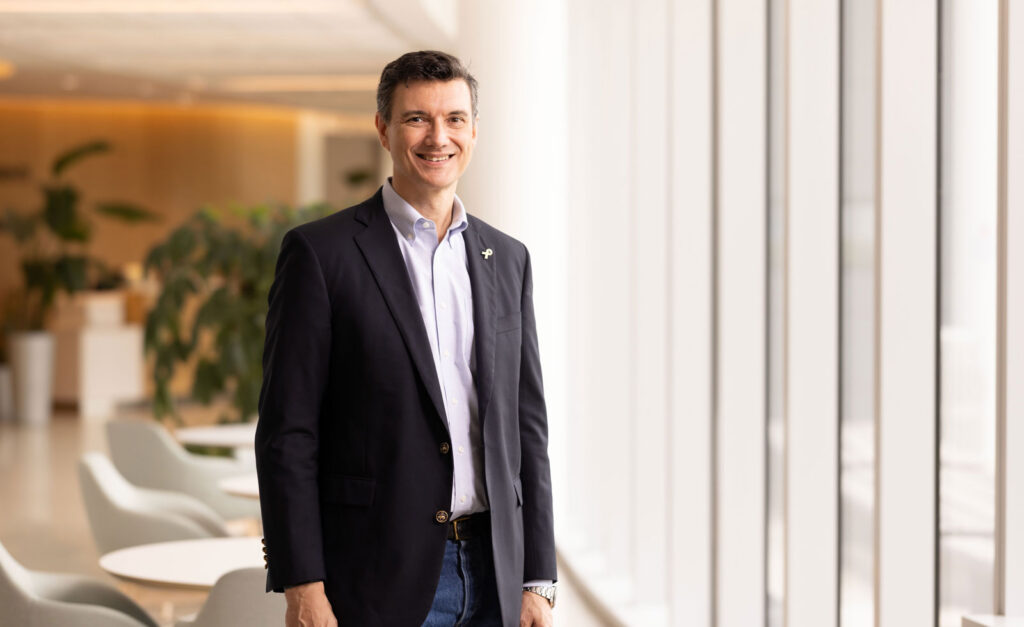
An interview with Alexander Bishop, DPhil, director of the Center for Childhood Cancer Research, principal investigator and Richard J. Solove Endowed Chair in Cancer Clinical Developmental Therapeutics at Nationwide Children’s Hospital.
At Nationwide Children’s Hospital, the mission of the Center for Childhood Cancer Research (CCCR) is to expand the understanding of childhood cancer pathogenesis and improve diagnosis and treatment strategies.
What made you decide to pursue a career in research, and what was your path to your current role?
My parents are both scientists; they were involved in molecular virology, so I was exposed to (bench) research from an extremely early age. Although I considered other careers, I couldn’t escape the conversations, the intrigue, the possibilities of making a real impact [through research]. I started chasing that pathway, which led me through my undergraduate and doctoral studies. I realized through my PhD studies that I wanted to do something more relevant to human disease, something that could have a direct medical impact, which got me thinking more about cancer and cancer predisposition, ultimately leading to pediatric cancers. What stayed with me was the gap between what we can explain in the lab and what families need in the clinic: clearer answers, better options and fewer long-term consequences of treatment.
I think the field of pediatric cancer research is especially compelling because the need is urgent and the community is unusually mission driven. I wanted to work alongside researchers and clinicians who are focused first on moving the science forward for children and families, not on individual credit or career milestones. That became very real to me early on when I met a child with Bloom syndrome who developed cancer, and I helped the family the family by developing a genetic test to understand who else might carry the same inherited risk. Experiences like that reinforced that this work is ultimately about children and families, and about translating science into better care.
Why did you decide to pursue your work at Nationwide Children’s Hospital?
I was immediately struck by the level of investment Nationwide Children’s has made in its research enterprise; it’s truly phenomenal. That commitment creates real opportunities to make a difference, not just through my own work but by supporting and elevating the incredible scientists already here.
What initially drew you to focus your research on pediatric sarcomas, and how has that focus evolved over time?
My path to pediatric sarcoma research really began with my background in DNA damage, DNA repair and genome instability. Earlier in my career, I worked on rare inherited cancer-predisposition syndromes, conditions like Bloom syndrome, Ataxia-telangiectasia and Li-Fraumeni syndrome. These disorders were scientifically compelling and taught me a great deal, but they aren’t the cancers most children face in the clinic. I wanted to focus my work where my expertise in genome stability could have a more direct and meaningful impact for patients and families.
That search led me to Ewing sarcoma. What immediately stood out was how extraordinarily sensitive Ewing sarcoma cells are to many forms of DNA damage. There have been reports suggesting they respond to PARP inhibitors (targeted cancer therapies that prevent cancer cells from repairing their DNA) , which pointed toward an underlying DNA repair defect, yet no one knew what that defect actually was. At the same time, these tumors often develop resistance to genotoxic chemotherapies, and for many years there were no effective second-line treatments. That combination of clear biological signal and serious unmet clinical need made me feel there was a real opportunity to uncover something important that could translate into better options for children. In other words, the biology pointed to a vulnerability, and the unmet need made it urgent to find it.
I started working on Ewing sarcoma, and along the way, some of the people who encouraged that direction have shaped my career ever since. Stephen Lessnick, MD, PhD, who wasn’t at Nationwide Children’s at the time, visited my lab early on and urged me to pursue Ewing sarcoma more seriously. Later, he became director of this very center (CCCR). My focus grew organically, from understanding fundamental DNA repair pathways, to realizing Ewing sarcoma posed unanswered biological questions tailor-made for that background, to continuing the work through a series of mentors and leaders who believed in its importance. And now, I’m still committed to unraveling this disease and pushing the science forward with patients at the center of that effort.
How is your lab approaching the development of new therapeutic strategies or identifying potential vulnerabilities in sarcoma cells?
In my lab, we start by dissecting the underlying biology of Ewing sarcoma. When I entered the field, very little was known beyond the presence of the fusion protein that causes this disease. So, we took an approach that ultimately revealed the fusion has two major functions: it drives aberrant transcription and disrupts protein interactions involved in genome maintenance. That second function creates a subtle but exploitable DNA repair and replication-stress vulnerability.
Our strategy is to leverage those weaknesses rather than try to “fix” them. We systematically map dependencies, test how they influence therapeutic windows and generate proof-of-concept evidence for targets that may later be developed clinically. That often means pairing genetic dependency mapping with drug-response studies in models that capture how these tumors behave, then using those results to define biomarkers and rational combinations.
At the center level, we’re extending this approach across multiple sarcomas, while also building strengths in cell therapies, viral delivery systems and brain tumor research. A major focus for the next few years is establishing a patient-derived organoid screening platform to rapidly evaluate drug responses and generate molecular-clinical datasets. These data will help guide clinical decision-making and fuel new biological hypotheses.
What do you see as the biggest scientific or clinical challenges in improving outcomes for children with sarcoma?
One of the biggest challenges is simply scale. Pediatric sarcomas are rare, and diseases like Ewing sarcoma have only about 200 new cases per year in the United States. Even if we discover a highly promising therapeutic approach, it’s incredibly difficult to run a meaningful clinical trial for such a small, geographically dispersed patient population. Building the kinds of national or international networks required to test new therapies is essential, but it’s also slow and resource-intensive.
The other persistent barrier is funding. Pediatric sarcoma research remains historically underfunded compared to adult cancers. That gap affects everything from early-stage discovery research to the ability to launch the collaborative clinical studies these patients desperately need. While the science is moving forward, improving outcomes ultimately depends on overcoming these structural hurdles: securing sustained investment in pediatric cancer research and creating trial infrastructures that can evaluate new treatments for very small patient populations. That’s why shared trial networks, harmonized data and sustained investment are so critical: they let us learn faster from every patient.
How does collaboration factor into your research?
I think collaboration is essential. Every lab has its own expertise, but when we build strong partnerships, we move faster, and the science is better. In rare diseases, collaboration isn’t just helpful, it determines whether a question is answerable at all. Many of the most impactful papers I’ve been part of only came together because a whole community of collaborators contributed the final pieces needed to complete the story.
In pediatric cancer research, collaboration is even more critical. Resources are limited, whether it’s funding, access to patient samples or specialized technical expertise, so no single lab can cover all the ground alone. To make meaningful progress, we rely on a network of colleagues who are willing to share insights, reagents and ideas, and that only works if we’re equally committed to being good collaborators ourselves.
When I stepped into this role, I found a center with outstanding faculty and strong science. My approach has been to empower our investigators rather than prescribe a top-down vision, giving them ownership of seminar planning, recruitment efforts and strategic initiatives, so the direction of the center reflects their expertise and aspirations.
From your perspective, what tools or technologies are most transformative right now for advancing childhood cancer research?
The most transformative advances are happening in immunotherapy and in the development of more clinically relevant disease models. Immunotherapy, especially NK cell-based approaches, is incredibly promising and having strong in-house expertise puts us in a great position to push that forward.
At the same time, moving beyond decades-old cell lines to patient-derived xenografts, zebrafish models and next-generation organoids gives us tools that much more accurately reflect pediatric tumors. These systems let us ask better questions, test therapies more realistically and ultimately move promising ideas into the clinic faster. Together, improved models and evolving immune-based therapies are reshaping what’s possible in childhood cancer research. The goal is to make our models predictive enough that when we move a therapy forward, whether targeted or immune-based, we do it with the right patients, the right combinations and the right biomarkers from the start.
What areas of childhood cancer research are you most excited about right now, and where do you see the field heading in the next few years?
I’m most excited about the momentum around precision medicine. We’re moving beyond thinking about rare pediatric cancers strictly by their diagnosis and instead focusing on the specific molecular alterations that drive them. That shift opens entirely new possibilities. For example, a mutation like STAG2 may only appear in a small fraction of Ewing sarcoma cases, but it’s common across several adult cancers. If we target the mutation rather than the disease label, we immediately expand the therapeutic landscape and make drug development far more viable. This also changes trial design: instead of asking whether a drug works for one diagnosis, we can ask whether it works for the patients whose tumors share a specific vulnerability.
This “mutation-first” approach has the potential to transform how we identify vulnerabilities and match patients to therapies, particularly in rare childhood cancers, where traditional drug development isn’t economically attractive.
In the next few years, I expect the field to lean more toward disease-agnostic, alteration-driven strategies, allowing pediatric cancers to benefit from advances in broader oncology. At the same time, artificial intelligence will help us integrate and interpret the growing volume of genomic, research and clinical data we generate. Together, that creates a real opportunity for a major leap in identifying therapeutic vulnerabilities and translating them into better options for patients. It’s an exciting direction because it can expand treatment possibility for children with cancers that historically have had very limited options.
Image credit: Nationwide Children’s Hospital
About the author
Madison Storm is the Senior Strategist of Research Communications at Nationwide Children's Hospital. She earned her bachelor's in multimedia journalism from Virginia Tech in 2021 and went on to achieve her master's in health communication from Johns Hopkins University in 2023. Her passion for transforming the complex to clear is supported by various experiences writing for consumer audiences.
- Madison Stormhttps://pediatricsnationwide.org/author/madison-storm/

- Madison Stormhttps://pediatricsnationwide.org/author/madison-storm/
- Madison Stormhttps://pediatricsnationwide.org/author/madison-storm/

- Madison Stormhttps://pediatricsnationwide.org/author/madison-storm/