

Lowering Thrombin Levels Offers a Double Benefit in Glomerular Disease Model
Lowering Thrombin Levels Offers a Double Benefit in Glomerular Disease Model https://pediatricsnationwide.org/wp-content/uploads/2026/03/Gloms-1-header-for-web-1024x410.jpg 1024 410 Katie Brind'Amour, PhD, MS, CHES https://pediatricsnationwide.org/wp-content/uploads/2021/03/Katie-B-portrait.gif
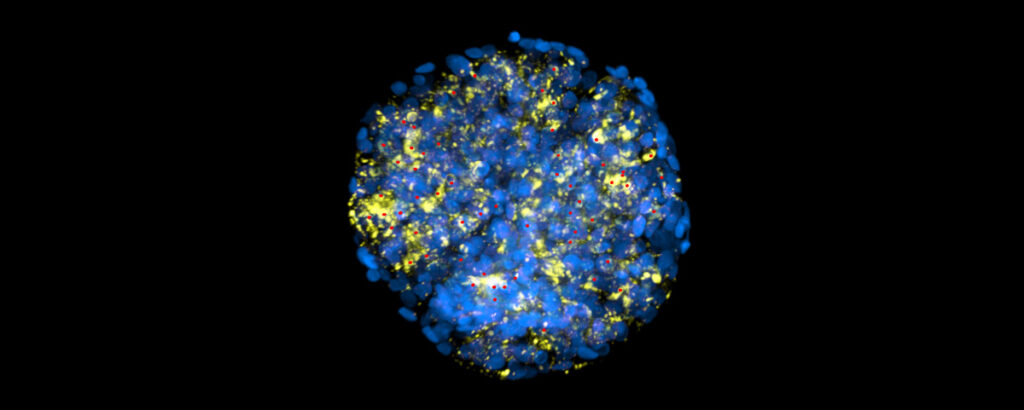
Preclinical studies suggest that reducing levels of the clotting enzyme may simultaneously reduce kidney damage and lower risk of blood clots.
Preclinical research in an in vivo model now confirms what Bryce Kerlin, MD, and his team first proposed in a publication 8 years ago: excess thrombin directly injures podocytes, and high levels in the blood and urine promote proteinuria, hypercoagulation and kidney damage.
“It took a very complicated set of experiments to test the hypothesis in podocytes and glomeruli in living kidney, instead of just cultured cells in a petri dish,” says Dr. Kerlin, hematologist and principal investigator in the Center for Clinical and Translational Research at Nationwide Children’s Hospital.
The latest of his team’s related publications became the July 2025 cover story for the Journal of the American Society of Nephrology, which shared a new way to count podocytes (see image at right) and the details of in vivo rat models to study the impact of thrombin. The team provoked glomerular disease in the model, then administered intravenous prothrombin protein to some of the rats and an anti-prothrombin therapy (antisense oligonucleotides) to others. They used healthy controls as well as rats with glomerular disease but no prothrombin-related treatments for comparison.
After 10 days, they examined a wide variety of kidney health markers. Rats that received the anti-prothrombin therapy had less prothrombin colocalized with podocytes, less tubular injury and podocyte foot process effacement, less podocytopathy and proteinuria, better plasma albumin levels and improved podocytopenia compared to rats given extra prothrombin.
“Extra prothrombin exacerbated kidney disease, while knocking it down significantly rescued the disease,” says Dr. Kerlin.
If thrombin functions similarly in humans with glomerular disease, inhibiting thrombin production could hold tremendous potential for simultaneously ameliorating kidney damage — slowing or preventing the progression to chronic kidney disease — and reducing the risk of deadly blood clots that represent a major risk to such patients. High-quality clinical trials will be required to determine what effect prophylactic anticoagulant therapies may have on disease remission and venous thromboembolism risk.
The many steps required to translate these findings to the clinic are already in Dr. Kerlin’s long-term plans, but he cautions that even using FDA-approved anticoagulants, enough data to justify practice changes could be a decade away — or more.
“Every scientist’s dream is to get something beneficial to patients into the clinic,” says Dr. Kerlin, who hopes this vein of study may be a significant opportunity to improve kidney health for millions of patients. “Getting over that hump is difficult. We have a lot of work to do.”
This article appeared in the 2026 Spring/Summer issue. Download the issue here.
References:
- Waller AP, Wolfgang KJ, Pruner I, Stevenson ZS, Abdelghani E, Muralidharan K, Wilkie TK, Blissett AR, Calomeni EP, Vetter TA, Brodsky SV, Smoyer WE, Nieman MT, Kerlin BA. Effects of prothrombin on podocytopathy and proteinuria in glomerular disease. Journal of the American Society of Nephrology. 2025 Mar 28;36(7):1327-1342.
- Sharma R, Waller AP, Agrawal S, Wolfgang KJ, Luu H, Shahzad K, Isermann B, Smoyer WE, Nieman MT, Kerlin BA. Thrombin-induced podocyte injury is protease-activated receptor dependent. Journal of the American Society of Nephrology. 2017 Sep;28(9):2618-2630.
Image Credit: Nationwide Children’s (provided by the Kerlin Lab)
About the author

Katherine (Katie) Brind’Amour is a freelance medical and health science writer based in Pennsylvania. She has written about nearly every therapeutic area for patients, doctors and the general public. Dr. Brind’Amour specializes in health literacy and patient education. She completed her BS and MS degrees in Biology at Arizona State University and her PhD in Health Services Management and Policy at The Ohio State University. She is a Certified Health Education Specialist and is interested in health promotion via health programs and the communication of medical information.
- Katie Brind'Amour, PhD, MS, CHEShttps://pediatricsnationwide.org/author/katie-brindamour-phd-ms-ches/

- Katie Brind'Amour, PhD, MS, CHEShttps://pediatricsnationwide.org/author/katie-brindamour-phd-ms-ches/
- Katie Brind'Amour, PhD, MS, CHEShttps://pediatricsnationwide.org/author/katie-brindamour-phd-ms-ches/
- Katie Brind'Amour, PhD, MS, CHEShttps://pediatricsnationwide.org/author/katie-brindamour-phd-ms-ches/