
Beyond the Clinic: Bipolar Disorder Care Where Kids Live, Learn and Grow
Beyond the Clinic: Bipolar Disorder Care Where Kids Live, Learn and Grow https://pediatricsnationwide.org/wp-content/uploads/2026/09/Green-Circles-1024x320.jpg 1024 320 Madison Storm https://pediatricsnationwide.org/wp-content/uploads/2023/09/092023BT159.png

For many children and adolescents with bipolar disorder, care begins in a crisis: severe mood symptoms, suicidality or hospitalization. They are evaluated in an emergency department or admitted for inpatient care. Stabilization is an immediate priority. But what happens next?
A new state-of-the-field review from Eric Youngstrom, PhD, director of the Institute for Mental and Behavioral Health Research at Nationwide Children’s argues that bipolar disorder care must move beyond crisis response and specialty clinics to support children where they live and learn, with an emphasis on earlier identification, prevention and individualized treatment.
“The future of bipolar disorder management must move beyond the walls of specialty clinics and hospitals and into the community,” Dr. Youngstrom says.
This shift reflects a broader rethinking of bipolar disorder in youth, one that emphasizes predicting risk earlier, continuous monitoring to prevent escalation and tailored care for long-term developmental outcomes.

``The future of bipolar disorder management must move beyond the walls of specialty clinics and hospitals and into the community.``
– Eric Youngstrom, PhD, director of the Institute for Mental and Behavioral Health Research
From Crisis Response to Lifelong Management
Crisis management will always be an essential component of bipolar disorder treatment, but it no longer defines success. Instead, the field is moving toward a proactive, longitudinal framework grounded in three priorities:
- Prediction: Identifying which youth are most at risk — often before a clear diagnosis, using family history, symptom patterns and screening tools
- Prevention: Intervening early to reduce symptom severity, delay onset or prevent progression
- Personalization: Adapting care over time based on developmental stage and functional needs
“The burden and challenges associated with pediatric bipolar disorder are not limited to those acute, episodic moments,” says Ian McKay, PhD, clinical psychologist in the Department of Psychiatry and Behavioral Health at Nationwide Children’s. “Families often describe months or years of disrupted sleep, mood instability and social or academic impairment before anyone names what’s happening.”
That shift changes how clinicians measure progress. A more comprehensive approach means considering how a young person is functioning across the board.
“In many youth cases, a spectrum of risk is the most clinically useful approach. We shouldn’t wait until things become severe, or someone meets the full diagnostic criteria, to get involved,” Dr. McKay adds. “There is a lot of opportunity during critical developmental periods to intervene earlier, track symptoms over time and help reduce how serious things become.”
“Crisis management is a big part of the care and it’s important,” says David Axelson, MD, chief of the Department of Psychiatry and Behavioral Health and the Section of Psychiatry at Nationwide Children’s. “We really want to help youth with bipolar spectrum disorders grow and develop and function broadly beyond just the crisis.”
Dr. Youngstrom frames this comprehensive approach as a move from short-term stabilization to sustained management and health promotion, assessing how youth are function across all domains, not just during acute episodes.
“The most effective care is embedded in daily life,” he explains. “Treatment success should be measured by thriving; reclaiming school, work and relationships.”
Rethinking Diagnosis: From Binary to Spectrum
In children and adolescents, bipolar disorder rarely presents as a clear-cut diagnosis. Symptoms overlap with more common conditions such as ADHD, anxiety and depression. Developmental state further complicates interpretation.
“In kids and teenagers, sometimes it’s hard to have a definite diagnosis, so you have to think about it more probabilistically,” says Dr. Axelson.
This probabilistic model represents a fundamental change. Rather than asking whether bipolar disorder is present, clinicians consider where they fall along a spectrum of risk. This approach integrates multiple sources of information — family history, symptom patterns and standardized screening tools — to estimate likelihood and guide decision-making over time.
“There’s a lot of gray area,” Dr. Axelson adds. “We’re often seeing presentations very early in the course of illness, and it might not be clear.”
Dr. Youngstrom’s framework of Evidence-Based Assessment reinforces this approach, using iterative data, such as screening scores and historical factors, to refine diagnostic probabilities and inform care decisions.
“Rather than viewing diagnosis as a static, one-time decision, this approach uses iterative information to shift probabilities and improve decision-making,” Dr. Youngstrom explains.
This model allows clinicians to act earlier, even when diagnostic certainty remains incomplete.
Identifying Risk Earlier
If bipolar disorder exists along a spectrum, early identification becomes both more possible and more necessary. Early recognition depends on moving screening into routine care. This makes routine pediatric visits a critical opportunity to detect early warning signs, particularly for children with known risk factors.
“The role of primary care is identifying kids that may be at risk,” Dr. Axelson says.
“It’s really the front door,” Dr. McKay agrees. “Primary care is where concerns first surface, and ideally it’s part of a team-based system where behavioral health and specialty care help guide next steps.”
Dr. Youngstrom’s review emphasizes tiered screening approaches that start with broad tools and progress to more specific measures when concerns arise. These strategies help detect youth who may not yet meet diagnostic criteria but still warrant monitoring.
“Children of parents with bipolar disorder have a five- to ten-fold increased risk,” Dr. Youngstrom says, noting that this information should anchor assessment decisions.
Early warning signs often appear as patterns rather than isolated symptoms, including episodic changes in sleep, energy and functioning, especially when paired with family history. Dr. Axelson emphasizes the same point in clinical practice.

``If somebody's not responding well to usual treatment and there's a family history of bipolar illness, that should be considered. Although bipolar disorder is not common, it is also not rare. This likely affects about 2% of children eventually, so you have to think about it.``
– David Axelson, MD, chief of the Department of Psychiatry and Behavioral Health and the Section of Psychiatry at Nationwide Children’s
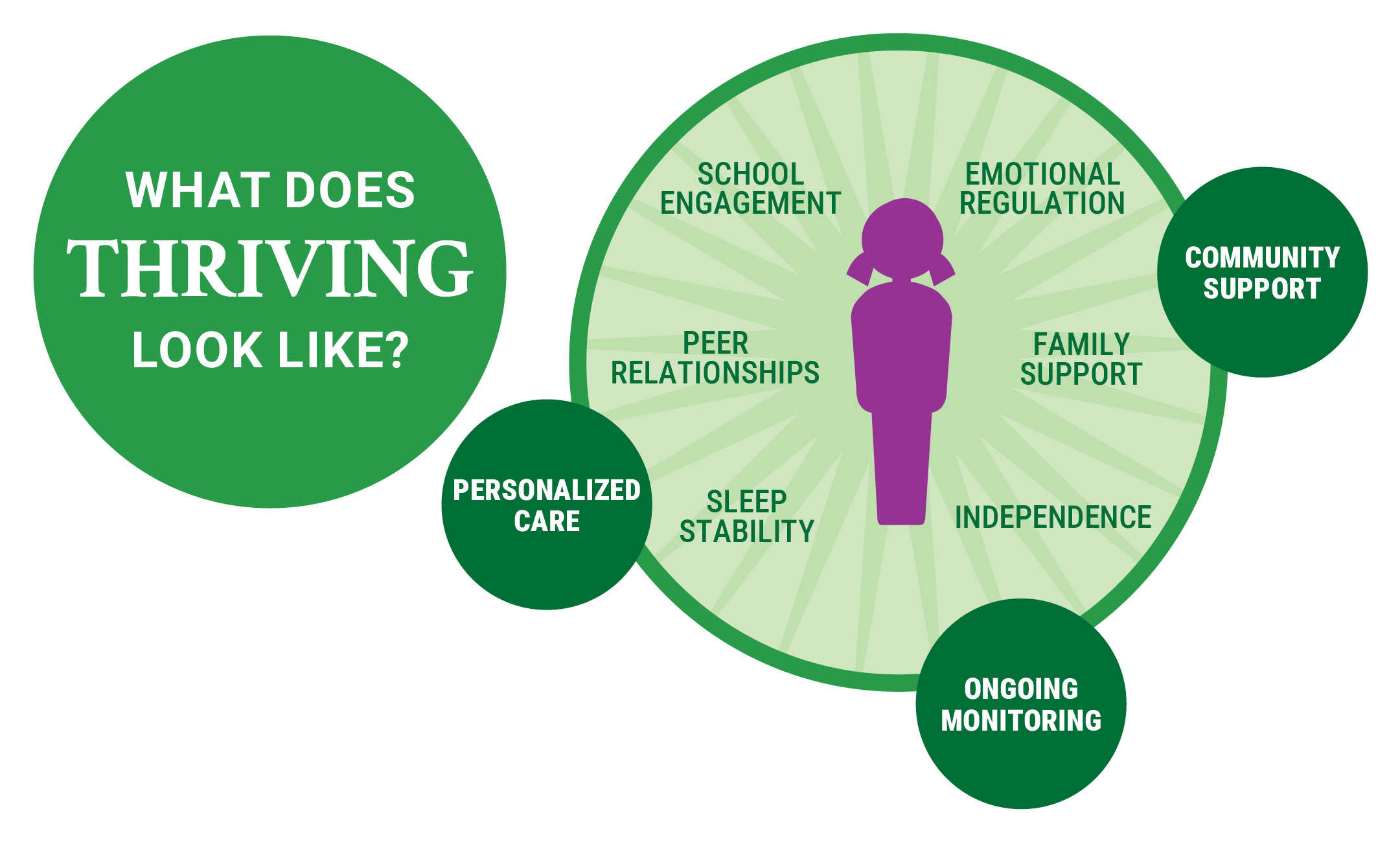
Beyond Symptom Reduction: Redefining Success as Thriving
Another major shift is redefining treatment success. Symptom stabilization remains the foundation of care, but it does not define the endpoint.
“Thriving means more than just fewer symptoms,” Dr. McKay says.
Many youth bipolar disorder continue to experience subthreshold symptoms even outside of acute episodes. These lingering effects can interfere with development and daily functioning.
As a result, treatment goals must expand beyond symptom control to include developmental progress:
- Regular school attendance
- Participation in extracurricular activities
- Building and maintaining peer relationships
- Building independence
“Trying to think about achieving normal developmental goals is really important,” Dr. Axelson says.
Community-Based Care: Bringing Treatment Into Everyday Life
Because bipolar disorder affects so many areas of life, effective care must extend beyond clinical settings. Community-based care is not simply an extension of treatment — it is where much of the ongoing work happens.
Schools play a central role in supporting youth with bipolar disorder.
“These kids struggle in school, so having therapists or interventions there can be important,” Dr. Axelson notes.
Supports such as individualized education plans and school-based mental health services can help maintain stability during vulnerable periods and reduce disruptions to learning and social development.
Family involvement is equally important. Much of the day-to-day management of bipolar disorder, including sleep routines, stress management and medication adherence, depends on consistent support at home. Dr. Youngstrom highlights practical interventions that are “sensible, easy, cheap and safe,” including sleep hygiene and behavioral support.
To make these supports more accessible, Nationwide Children’s continues to expand programs that connect specialty expertise with community care. Behavioral health integration within primary care practices further supports early identification and intervention in familiar settings. Consultation services such as Behavioral Health Treatment Insights and Provider Support (BH-TIPS) allow primary care providers to connect directly with pediatric psychiatrists for diagnostic and treatment guidance.
“That can be a very good resource for someone who’s not sure if bipolar disorder should be in the differential,” says Dr. Axelson. “These clinicians can help identify kids that may be struggling and get them to specialty care.”
For youth transitioning out of crisis care, programs such as the Critical Assessment and Treatment Clinic at Nationwide Children’s provide short-term follow-up and stabilization, helping bridge the gap between inpatient treatment and ingoing community support.
These initiatives reflect a broader goal: bringing evidence-based tools beyond specialty cllinics and into everyday care environments.
Community Care Challenges Across the Lifespan
Despite progress, access to care remains a major challenge.
“There is a significant access gap where the most cost-effective community treatments are unavailable in the regions that need them most, often leading to the incarceration of minority youth rather than clinical treatment,” Dr. Youngstrom says. “The most vital challenge is translation — turning new science into something that actually reaches the people who need it.”
Delays of weeks or even months can leave youth vulnerable during critical periods of recovery. Access to intensive community-based services remains limited in many areas, while workforce shortages often make it difficult for families to receive care as frequently as needed.
Care coordination presents another challenge. Managing bipolar disorder often involves multiple systems, including psychiatry, therapy, primary care and schools, all of which must communicate effectively to support a young person’s changing needs.
“You want good coordination between providers, and that communication can be challenging,” Dr. Axelson says.
These coordination challenges often become even more apparent as adolescents transition into adulthood. The move from pediatric to adult services can create disruptions in care, particularly because adult treatment systems may place less emphasis on family involvement and community supports.
“That transition can be tough,” Dr. Axelson says. “Not waiting until the last minute and taking a thoughtful approach as someone reaches 17 or their last year of high school [can help ease the transition].”
Planning early, maintaining continuity whenever possible and establishing clear handoffs between providers can help reduce gaps during this vulnerable period and support long-term stability.
Looking Ahead: A Community-Based Future
This shift outlined by Dr. Youngstrom calls for a shift in perspective as much as in practice. Bipolar disorder is not defined by isolated episodes. This is a condition that develops over time and affects multiple domains of a young person’s life, reshaping the role of pediatric providers and the goal of care.
“Bipolarity is a spectrum. Move away from rigid categorical boxes and toward a dimensional model — ask ‘How bipolar is this presentation?’ rather than ‘if’ it is bipolar,” Dr. Youngstrom says.
Clinicians are not only managing symptoms; they are supporting a trajectory, helping young people build the skills and stability needed for long-term success.
“We may not have a definite diagnosis yet,” Dr. Axelson says. “We may need to try different things and reassess over time.”
Expanding care into community setting creates more opportunities to intervene earlier, monitor more effectively and support families over the long term. The result is a model that meets children where they are and helps them move forward.
References
Youngstrom EA. Assessment and Treatment of Bipolar Disorder in the Community. Annual Reviews in Clinical Psychology. 2026;22(1):343-371.
About the author

Madison Storm is the Senior Strategist of Research Communications at Nationwide Children's Hospital. She earned her bachelor's in multimedia journalism from Virginia Tech in 2021 and went on to achieve her master's in health communication from Johns Hopkins University in 2023. Her passion for transforming the complex to clear is supported by various experiences writing for consumer audiences.
- Madison Stormhttps://pediatricsnationwide.org/author/madison-storm/

- Madison Stormhttps://pediatricsnationwide.org/author/madison-storm/
- Madison Stormhttps://pediatricsnationwide.org/author/madison-storm/

- Madison Stormhttps://pediatricsnationwide.org/author/madison-storm/