
Study Explores Impact of Duffy Null Phenotype on Neutrophil Count and Hydroxyurea Dosing in Children With Sickle Cell Disease
Study Explores Impact of Duffy Null Phenotype on Neutrophil Count and Hydroxyurea Dosing in Children With Sickle Cell Disease https://pediatricsnationwide.org/wp-content/uploads/2021/03/AdobeStock_4366150-1024x683.jpg 1024 683 Lauren Dembeck https://pediatricsnationwide.org/wp-content/uploads/2021/03/Dembeck_headshot.gif

Children with sickle cell disease and the Duffy null phenotype may have lower measured neutrophil counts, but new research suggests that there are opportunities to optimize hydroxyurea regardless of Duffy null status.
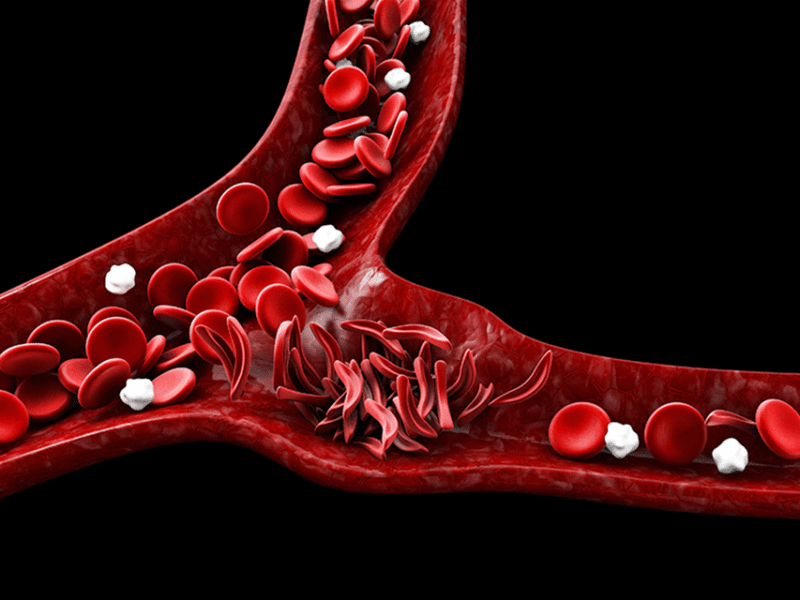
Sickle cell disease (SCD) primarily affects individuals of minority populations and can cause numerous morbidities, including vaso-occlusive pain, acute chest syndrome episodes, and stroke. Hydroxyurea is the first-line disease-modifying therapy for children with SCD, and it can be started as early as 9 months of age. It induces fetal hemoglobin production and reduces many SCD-related complications. However, hydroxyurea also reduces absolute neutrophil counts, which serves as a key factor in determining hydroxyurea dosing.
Another factor that reduces measured neutrophil counts and occurs in ≥75% of the SCD population in the United States is the Duffy null phenotype. This phenotype is common in people of African descent.
“In people with the Duffy null phenotype, neutrophils tend to move out of bloodstream and into the tissues. They still have enough neutrophils in their body, so it doesn’t cause any negative effects like increased risk of infection,” explains Susan Creary, MD, Associate Professor of Pediatrics and pediatric hematologist in the Division of Hematology, Oncology, and Blood and Marrow Transplant (BMT) at Nationwide Children’s Hospital. “However, when we adjust medications, we use neutrophil counts that are circulating in the bloodstream, not the tissues; so, these individuals may appear to have lower neutrophil counts, when their measured counts are actually artifactually low.”
The impact of the Duffy null phenotype on absolute neutrophil counts and hydroxyurea dosing in children and adolescents with SCD over time is not well understood. Thus, Dr. Creary and colleagues conducted a retrospective study to determine if there was a difference in absolute neutrophil counts among children with SCD with and without the Duffy null phenotype from ages 2 to 9 years who were untreated with hydroxyurea. They also evaluated whether hydroxyurea dosages differed over time between those with and without the Duffy null phenotype who initiated hydroxyurea treatment after 1 year of age.
“Hydroxyurea is a medication that somebody could potentially use for their lifetime and optimizing the dose of hydroxyurea has been shown to improve outcomes,” adds Dr. Creary, who is also a principal investigator in the Abigail Wexner Research Institute at Nationwide Children’s. “While we had previously looked at young children, we wanted to ensure that having the Duffy null phenotype wasn’t impacting hydroxyurea dosing in older children and ultimately, its benefits.”
The study, which was published in Pediatric Blood & Cancer, found that all children, regardless of their Duffy phenotype, who were not receiving hydroxyurea had stable absolute neutrophil counts through 9 years of age, but those with the Duffy null phenotype had lower mean absolute neutrophil counts starting at 6 years of age. Among children receiving hydroxyurea, the investigators found that absolute neutrophil counts increased over time, regardless of Duffy null phenotype.
“Our study was conducted at a single institution and with a fairly small size sample size. However, we found that neutrophil counts in those with and without Duffy null were higher than our target neutrophil counts for youth on hydroxyurea. This suggests there are opportunities to optimize hydroxyurea exposure, through improved adherence and dosing, among all children with sickle cell disease,” says Dr. Creary.
Going forward, the team would like to evaluate if having the Duffy null phenotype influences hospitalized and older individuals with SCD.
“More studies are needed to further examine the full impact of the Duffy null phenotype on people with SCD. For example, we may see differences in clinical outcomes in patients with the Duffy null phenotype during admissions or among adolescents because this is when neutrophil counts and inflammation typically increase and SCD morbidity escalate,” says Dr. Creary.
Reference
Goldfarb N, Stanek J, Walden J, Rose MJ, Nicol K, Villella A, Young J, Creary S. Comparing Absolute Neutrophil Counts of Children With Sickle Cell Disease With and Without the Duffy Null Phenotype. Pediatric Blood and Cancer. 2025 Aug;72(8):e31794.
Image credit: Adobe Stock
About the author

Lauren Dembeck, PhD, is a freelance science and medical writer based in New York City. She completed her BS in biology and BA in foreign languages at West Virginia University. Dr. Dembeck studied the genetic basis of natural variation in complex traits for her doctorate in genetics at North Carolina State University. She then conducted postdoctoral research on the formation and regulation of neuronal circuits at the Okinawa Institute of Science and Technology in Japan.
- Lauren Dembeckhttps://pediatricsnationwide.org/author/lauren-dembeck/

- Lauren Dembeckhttps://pediatricsnationwide.org/author/lauren-dembeck/
- Lauren Dembeckhttps://pediatricsnationwide.org/author/lauren-dembeck/

- Lauren Dembeckhttps://pediatricsnationwide.org/author/lauren-dembeck/