
Supporting Brain Development While the Lungs Heal
Supporting Brain Development While the Lungs Heal https://pediatricsnationwide.org/wp-content/uploads/2026/08/Original_hi_res_JPG-081822BT385-for-web-1024x683.jpg 1024 683 Pam Georgiana https://pediatricsnationwide.org/wp-content/uploads/2023/07/May-2023.jpg
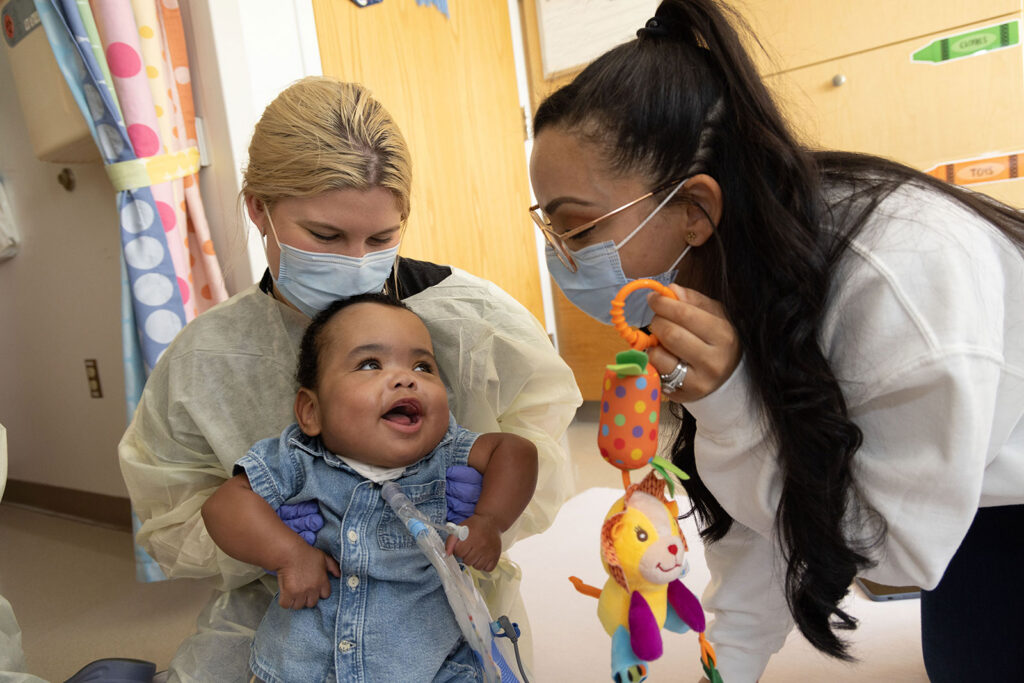
A new review presents a practical framework for incorporating neurodevelopmental care into the management of infants with severe bronchopulmonary dysplasia.
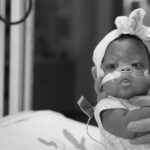
For infants with severe bronchopulmonary dysplasia (BPD), months in the Newborn Intensive Care Unit (NICU) can coincide with a critical period of brain development. Although treating severe lung disease is essential, clinicians at Nationwide Children’s Hospital know that supporting neurodevelopment cannot wait until an infant’s lungs have healed.
Respiratory support and sedation may be necessary to stabilize severe BPD. At the same time, prolonged exposure to sedating medications and limited opportunities for mobility and interaction may affect neurodevelopment. Infants with BPD are already at increased risk for motor, cognitive and language delays.
Audrey N. Miller, MD
A new review published in NeoReviews presents current evidence on neurodevelopmental outcomes in infants with BPD and offers recommendations for incorporating developmental care during hospitalization. The authors draw on published evidence as well as more than two decades of experience caring for infants with severe BPD at Nationwide Children’s.
“These infants may spend six months or longer in the hospital during a period when their brains are developing rapidly,” says Audrey N. Miller, MD, attending neonatologist at Nationwide Children’s and assistant professor of pediatrics at The Ohio State University College of Medicine. “We have to actively address every aspect of their care to support development while we are treating their lung disease.”
Although the risks are well established, less is known about how best to support brain development during prolonged hospitalization. There are currently no national guidelines for comprehensive neurodevelopmental care in infants with severe BPD.
The authors recommend making neurodevelopment part of everyday care and tailoring activities to each infant’s medical severity and developmental capacity. Stable respiratory support can allow even intubated infants to be comfortable and awake enough to move and interact with caregivers. Other recommendations include minimizing sedation when possible, protecting sleep and providing sensory and social experiences.
“The goal is to create positive developmental experiences throughout the day, rather than waiting until a child is ‘ready’ for therapy,” Kelly M. Susey, PT, CNT, physical therapist in neonatal therapy at Nationwide Children’s, explains. “That means having a unit culture that supports getting an infant out of bed and allowing parents to care for and hold their baby as often as possible.”

Kelly M. Susey, PT, CNT
Physical therapists support movement, sensory experiences and positioning that promote healthy brain development. At Nationwide Children’s, physical, occupational and speech therapists are embedded within the neonatology team. Nurses and respiratory therapists are also trained to manage ventilator tubing and equipment safely so developmental activities extend beyond scheduled therapy sessions.
“The severity of their lung disease doesn’t mean development has to stop,” Susey says. “We look at what each baby can tolerate that day and find opportunities for positive developmental activities within those limits.”
The approach also expands how the team measures progress. Weaning off respiratory support remains important, but developmental milestones matter as well. An infant who requires a ventilator can still build motor skills and participate more actively in their environment.
“We essentially create a chronic care rehabilitation environment where development can continue as the lungs grow and heal,” Dr. Miller explains. “It requires everyone, from leadership to nurses and therapists, to understand and support the same approach.”
The authors hope the review provides a functional care framework for other centers and informs the BPD Collaborative’s work toward national guidelines.
Reference:
Susey K, Hanin M, Dicari A, Cohen SH, Todd L, Miller AN. Optimizing Neurodevelopment in Infants With Severe Bronchopulmonary Dysplasia. Neoreviews. 2026;27(8):e479-e495. doi:10.1542/neo.27-7-037
Image Credit: Nationwide Children’s
About the author

Pam Georgiana is a brand marketing professional and writer located in Bexley, Ohio. She believes that words bind us together as humans and that the best stories remind us of our humanity. She specialized in telling engaging stories for healthcare, B2B services, and nonprofits using classic storytelling techniques. Pam has earned an MBA in Marketing from Capital University in Columbus, Ohio.
- Pam Georgianahttps://pediatricsnationwide.org/author/pam-georgiana/

- Pam Georgianahttps://pediatricsnationwide.org/author/pam-georgiana/

- Pam Georgianahttps://pediatricsnationwide.org/author/pam-georgiana/
- Pam Georgianahttps://pediatricsnationwide.org/author/pam-georgiana/