
Open-Source Tools to Profile Space-Time Slow Oscillations in Dormant Sleep Data
Open-Source Tools to Profile Space-Time Slow Oscillations in Dormant Sleep Data https://pediatricsnationwide.org/wp-content/uploads/2026/08/AdobeStock_30069695-1024x640.jpeg 1024 640 Jessica Nye, PhD https://pediatricsnationwide.org/wp-content/uploads/2021/09/JNye_glasses.png
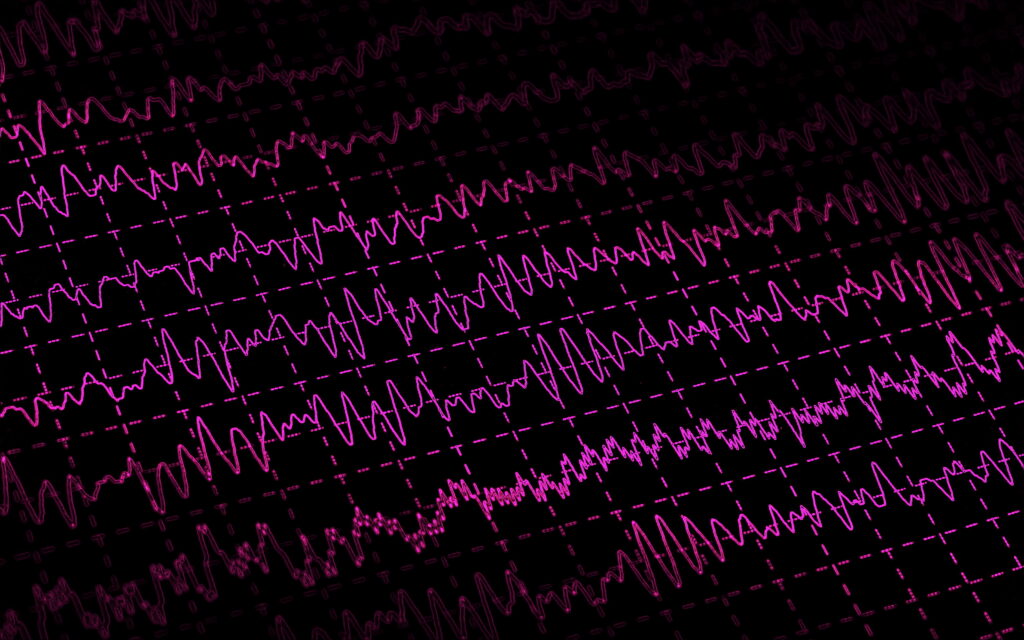
The Brain Rhythms Lab at Nationwide Children’s Hospital releases open-source tools for extracting space-time profiles in sleep data.
“The kind of thing we’d like to understand is what in the sleep neurophysiology of children with typical or atypical development can inform us on the relationship between sleep and cognition,” says Paola Malerba, PhD, principal investigator of the Brain Rhythms Lab at the Abigail Wexner Research Institute at Nationwide Children’s. “My goal is to look for things that are subtle, but they are mechanistically consequential, meaning things that are not obviously different, but they are just different enough that as they compound through night after night of sleep, you will see a sizeable effect in cognition, in behavior, in quality of life.”
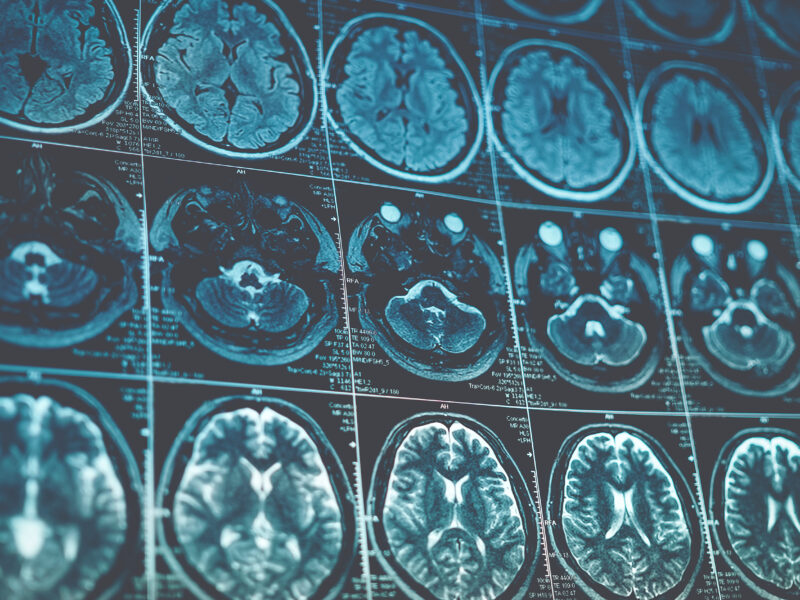
Dr. Malerba and colleagues describe an alternative approach to classify sleep slow oscillations (SOs) using low density electroencephalogram (EEG) data in a paper published in Neuroinformatics. In their previous work, they detected Global, Frontal and Local SO patterns using EEG data collected using at least 24 electrodes.
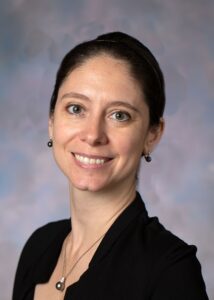
Paola Malerba, PhD
“In the previous study, we were doing data-driven science but with math from the 1980s. It allowed us to discover hidden structure in the data, but could not find this structure unless enough leads were placed on the scalp ¾ which is uncommon in clinical sleep measures. Now, using our early results and more recent algorithms and computational resources, we can see its structure in a data-driven way even when only few leads are available. You can build and train a classifier that first receives data that has been engineered and analyzed the old way, but then can you pare down the information,” says Dr. Malerba.
Using this approach, they were able to classify SOs using data from only eight, six and even four channels, which had test and validation accuracies higher than 75%, higher than 70% and around 70%, respectively.
“There is a lot of dormant sleep data out there. They might be imperfect because they were acquired for clinical reasons or are not perfectly polished, but the space-time information is inside those data sets,” says Dr. Malerba.
In a second paper published in SLEEP Advances, Dr. Malerba and colleagues describe the methods and provide the open-source code for extracting space-time SO profiles in EEG data.
“Now the tools are easily available, they have been pre-built with every step declared as clearly as possible. We aren’t giving people a black box to press a button and a miracle occurs. They get the code. There’s a user manual with supporting information. There are so many datasets that are just sitting there, and we could learn so much from them,” says Dr. Malerba.
She concludes, “If we look at sleep data in an informed way that leverages current technology and computational capabilities, and leverages the fact that subtle differences in the neurophysiology of sleep can really impact cognitive development and behavior as they compound night after night, if you take these two things together, we may be able to advance the field. To have techniques and tools that will allow us to resolve these differences and really reveal in a quantitative way, and potentially an individualized way, so that patients can be characterized and compared to more normative curves so we, in the future, can understand sleep neurophysiology better.”
References:
- Gaither J, White P, Mednick SC, Malerba P. Classifying Sleep Slow Oscillations in Low Density EEG. Neuroinformatics. 2026;24(2):18.
- Snedden A, Mednick SC, Malerba P. A user’s introduction to an algorithmic method to identify space–time profiles of sleep slow oscillations: dataset constraints, case-use examples, and open-source code. Sleep Adv. 2026;7(1):zpag024.
About the author
Jessica Nye, PhD, is a freelance science and medical writer based in Barcelona, Spain. She completed her BS in biology and chemistry and MS in evolutionary biology at Florida State University. Dr. Nye studied population genetics for her doctorate in biomedicine at University of Pompeu Fabra. She conducted her postdoctoral research on the inheritance of complex traits at the Autonomous University of Barcelona.
- Jessica Nye, PhDhttps://pediatricsnationwide.org/author/jessica-nye-phd/

- Jessica Nye, PhDhttps://pediatricsnationwide.org/author/jessica-nye-phd/

- Jessica Nye, PhDhttps://pediatricsnationwide.org/author/jessica-nye-phd/
- Jessica Nye, PhDhttps://pediatricsnationwide.org/author/jessica-nye-phd/