

Hot Topics in Endocrinology: A conversation with Joan Han, MD, Division Chief of Endocrinology at Nationwide Children’s
Hot Topics in Endocrinology: A conversation with Joan Han, MD, Division Chief of Endocrinology at Nationwide Children’s https://pediatricsnationwide.org/wp-content/uploads/2026/03/Original_hi_res_JPG-021926SC0354_Edit_hires-for-web-1024x605.jpg 1024 605 Pam Georgiana https://pediatricsnationwide.org/wp-content/uploads/2023/07/May-2023.jpg
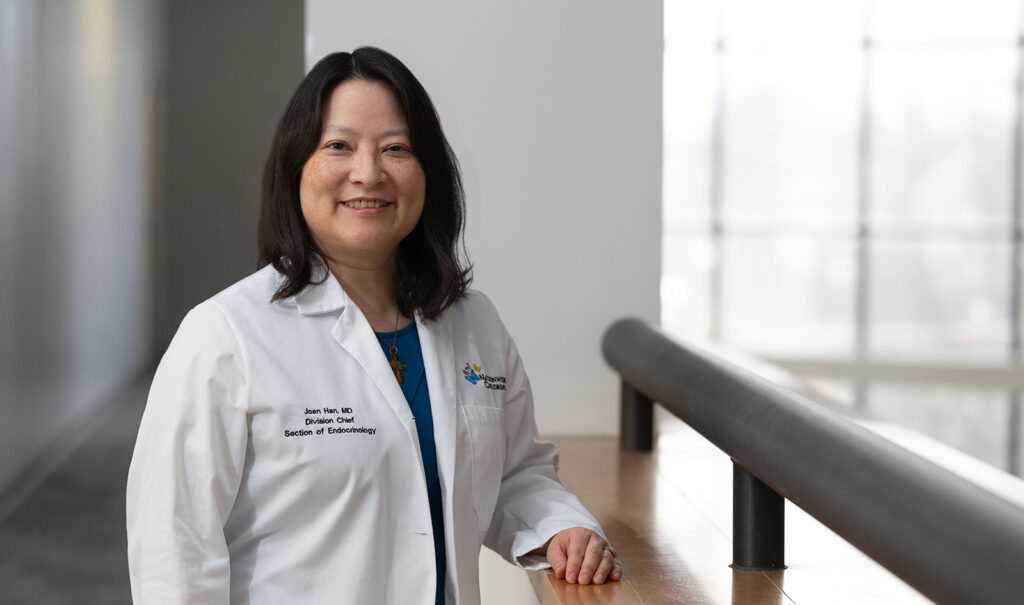
Joan C. Han, MD, became chief of the Division of Endocrinology at Nationwide Children’s Hospital in January 2026. She is a nationally recognized physician-scientist in pediatric obesity and metabolic disease.
In this Q&A, Dr. Han discusses the most pressing issues in pediatric endocrinology and her vision for advancing clinical care and research at Nationwide Children’s.
Q: What are the “hot topics” in pediatric endocrinology today?
Pediatric obesity and type 2 diabetes are the most urgent challenges. Childhood obesity now affects 19.7% of U.S. youth. That’s roughly 14.7 million children and adolescents aged 2–19.
The downstream consequences are significant. About one-third of U.S. adolescents now have prediabetes. Over the past two decades, type 1 diabetes prevalence in youth has grown by 45%. Type 2 diabetes has increased by 95%. We are also seeing rising rates of hypertension, dyslipidemia, obstructive sleep apnea and insulin resistance.
At the same time, pediatric endocrinology is moving firmly into an era of precision medicine. Advances in genetics have reshaped our understanding of severe early-onset obesity and monogenic diabetes. For example, we now know that body fat and the gut are active endocrine organs. They secretes hormones that interact with the brain, liver, pancreas, stomach, skeletal muscle and even bone. These hormones regulate appetite, energy use and glucose levels. When these systems break down, significant metabolic disease can result.
Access to multidisciplinary care is equally critical. Endocrine disorders are chronic and complex. They demand coordinated nutrition, behavioral health and medical management. To support families, we must develop sustainable models for comprehensive care.
Q: What is the focus of your research, and how does it inform clinical care?
My research examines how the brain and hormone systems coordinate appetite and metabolism. Approximately half of body weight regulation is genetically influenced. The remainder reflects environmental and behavioral exposures. Understanding both sides of that equation is critical.
Early in my career, I studied children with rare genetic variants affecting the leptin pathway. That work contributed to clinical trials of targeted therapies, including setmelanotide, for specific genetic forms of obesity. For me, these studies reinforced an important principle: therapy should always align with underlying biology.
At Nationwide Children’s, I plan to expand translational research connecting genetics, physiology and clinical outcomes. I will use new research models to study variants in key metabolic pathways and search for new treatment targets. My goal is to move beyond symptom management and toward mechanism-based treatments.
Q: How will your prior experience building pediatric obesity programs inform your work at Nationwide Children’s?
In Tennessee, I developed a comprehensive pediatric obesity program that combined subspecialty care with school- and community-based outreach. In New York, we implemented a multidisciplinary “one-stop” clinic model that allowed families to see multiple providers in a single visit.
In both settings, one lesson was consistent: effective care must address lifestyle foundations, such as nutrition, physical activity, sleep and psychosocial health, alongside medical and genetic factors. Medications can be transformative for selected patients, but they are not substitutes for comprehensive care.
I look forward to collaborating with the Center for Healthy Weight and Nutrition. My vision is to build a robust research infrastructure on top of an already strong clinical network, creating a platform to test innovative interventions and disseminate best practices across central Ohio and beyond.
Q: Beyond obesity and diabetes, what are your broader goals for the division?
My goal is for each subspecialty area within endocrinology to become a destination program. That includes glucose metabolism, growth, puberty, bone health, thyroid and adrenal function, as well as rare genetic syndromes.
Achieving that status requires excellence in both care and discovery. We must support faculty development as clinician-investigators and create infrastructure for investigator-initiated research. This includes statistical support, research coordinators and philanthropic partnerships to launch early-stage projects.
Nationwide Children’s has an exceptional clinical foundation. I hope to cultivate a culture of discovery that permeates the division, from trainees to senior faculty. Innovation should not be confined to the laboratory. It should also extend to quality improvement, patient education and technology-enabled care delivery.
As she begins her tenure, Dr. Han is intent on aligning clinical excellence with scientific advancement.
“If we are going to change the trajectory of pediatric endocrine and metabolic diseases,” she says, “we must integrate precision medicine, multidisciplinary care and community engagement. Our patients deserve nothing less.”
Reference:
Braffett BH, Crume T, Bjornstad P, et al. Diabetes in Children and Adolescents. 2025 Dec 22. In: Lawrence JM, Casagrande SS, Herman WH, et al., editors. Diabetes in America [Internet]. Bethesda (MD): National Institute of Diabetes and Digestive and Kidney Diseases (NIDDK); 2023-. Available from: https://www.ncbi.nlm.nih.gov/books/NBK619869/
Image credit: Nationwide Children’s
About the author
Pam Georgiana is a brand marketing professional and writer located in Bexley, Ohio. She believes that words bind us together as humans and that the best stories remind us of our humanity. She specialized in telling engaging stories for healthcare, B2B services, and nonprofits using classic storytelling techniques. Pam has earned an MBA in Marketing from Capital University in Columbus, Ohio.
- Pam Georgianahttps://pediatricsnationwide.org/author/pam-georgiana/

- Pam Georgianahttps://pediatricsnationwide.org/author/pam-georgiana/

- Pam Georgianahttps://pediatricsnationwide.org/author/pam-georgiana/
- Pam Georgianahttps://pediatricsnationwide.org/author/pam-georgiana/