
How Diabetes Rewires the Heart’s Smallest Vessels
How Diabetes Rewires the Heart’s Smallest Vessels https://pediatricsnationwide.org/wp-content/uploads/2026/04/Mouse-Heart-Spatial-Transcriptomics_Stitched_RGB_with-spots-header-1024x597.jpg 1024 597 Lauren Dembeck https://pediatricsnationwide.org/wp-content/uploads/2021/03/Dembeck_headshot.gif
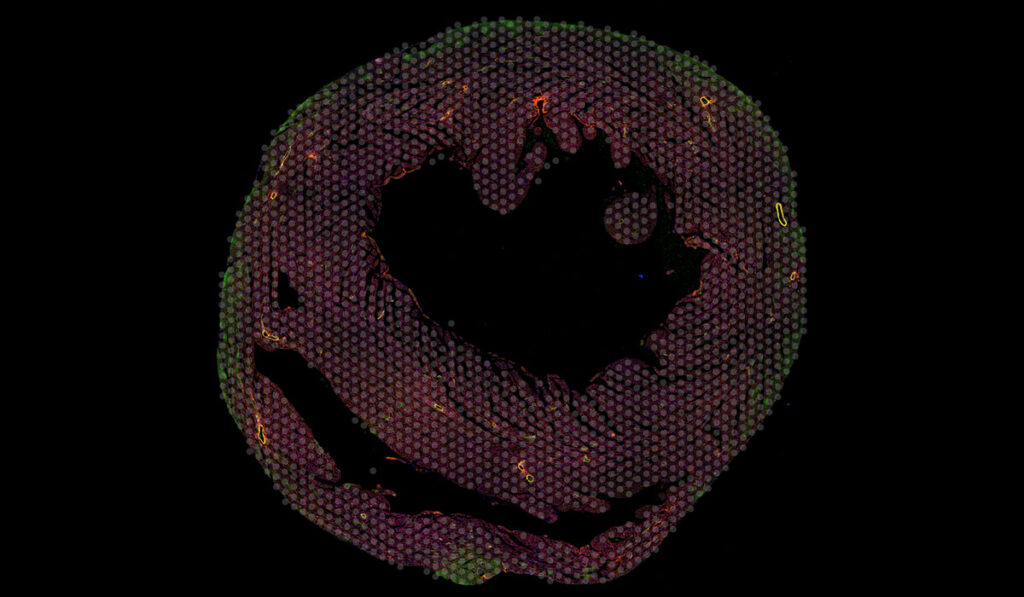
A landmark study uncovers how diabetes alters the heart at the cellular level.
Cardiovascular disease is the leading cause of death in type 2 diabetes. While its effects on large arteries are well recognized, growing evidence suggests the earliest cardiovascular injury occurs in the heart’s smallest vessels. Coronary microvascular disease (CMD), marked by impaired endothelial and smooth muscle function, adverse remodeling and reduced blood flow, can appear long before symptoms of heart failure. Yet the cellular mechanisms that drive this process have remained unclear.
A new study led by investigators at Nationwide Children’s Hospital offers the most detailed look to date at how diabetes alters the coronary microcirculation. Using single-cell RNA sequencing and spatial transcriptomics, the team mapped nearly 20,000 cells in diabetic and non-diabetic mouse hearts to understand how each cell type changes and where those changes occur.
Aaron Trask, PhD, FAHA, FCVS, principal investigator in the Center for Cardiovascular Research, led the work, which is published in Basic Research in Cardiology.
“We now have patients as young as five years old with type 2 diabetes,” Dr. Trask says. “The microcirculation is one of the first tissues to show signs of disease, so understanding what’s happening there is critical.”
Both the single-cell and spatial analyses revealed a consistent pattern: diabetes induces broad metabolic reprogramming across the microvasculature.
“We saw strong enrichment of pathways like oxidative phosphorylation and fatty acid metabolism across many cell types,” he says. “That wasn’t surprising in cardiomyocytes, but seeing that shift in vascular cells was somewhat unexpected.”
Adipogenesis-related genes were also elevated, even though true adipocytes were rare.
“Almost all the cell types were expressing adipogenic markers,” Dr. Trask notes. “That has really opened a new area of investigation for us.”
Spatial transcriptomics confirmed that these changes were concentrated in and around coronary resistance microvessels, which regulate coronary blood flow to the heart tissue. This approach also revealed altered communication networks among neighboring cells.
“We expected endothelial and smooth muscle cells to dominate vascular signaling, but fibroblasts emerged as major communicators,” he says. “That was surprising and suggests we may underappreciate their role.”
The team validated several of the most altered pathways using proteomic analysis of isolated coronary microvessels, strengthening confidence that the transcriptomic changes reflect true biological shifts. The findings provide a new framework for understanding how CMD develops at the earliest stages of diabetes, insights that may guide future therapies.
“If a pediatric patient has type 2 diabetes, they likely already have underlying microvascular disease,” Dr. Trask emphasizes. “We need to think about ways to treat early and prevent progression to heart failure.”
This article appeared in the 2026 Spring/Summer issue. Download the issue here.
Reference:
McCallinhart PE, Strawser CH, Garfinkle EAR, Navarro JB, McAllister C, Vetter TA, Lucchesi PA, Mardis ER, Mezache L, Veeraraghavan R, Miller KE, Trask AJ. Single cell and spatial transcriptomic profiling of the type 2 diabetic coronary microcirculation and myocardium. Basic Research in Cardiology. 2025 Dec;120(6):1109-1129.
Image Credit:
About the author

Lauren Dembeck, PhD, is a freelance science and medical writer based in New York City. She completed her BS in biology and BA in foreign languages at West Virginia University. Dr. Dembeck studied the genetic basis of natural variation in complex traits for her doctorate in genetics at North Carolina State University. She then conducted postdoctoral research on the formation and regulation of neuronal circuits at the Okinawa Institute of Science and Technology in Japan.
- Lauren Dembeckhttps://pediatricsnationwide.org/author/lauren-dembeck/

- Lauren Dembeckhttps://pediatricsnationwide.org/author/lauren-dembeck/
- Lauren Dembeckhttps://pediatricsnationwide.org/author/lauren-dembeck/
- Lauren Dembeckhttps://pediatricsnationwide.org/author/lauren-dembeck/