

The Growing Use of Robotics in General Pediatric Surgical Procedures
The Growing Use of Robotics in General Pediatric Surgical Procedures https://pediatricsnationwide.org/wp-content/uploads/2026/03/042424BT397-for-webjpg-1024x683.jpg 1024 683 Lauren Dembeck https://pediatricsnationwide.org/wp-content/uploads/2021/03/Dembeck_headshot.gif
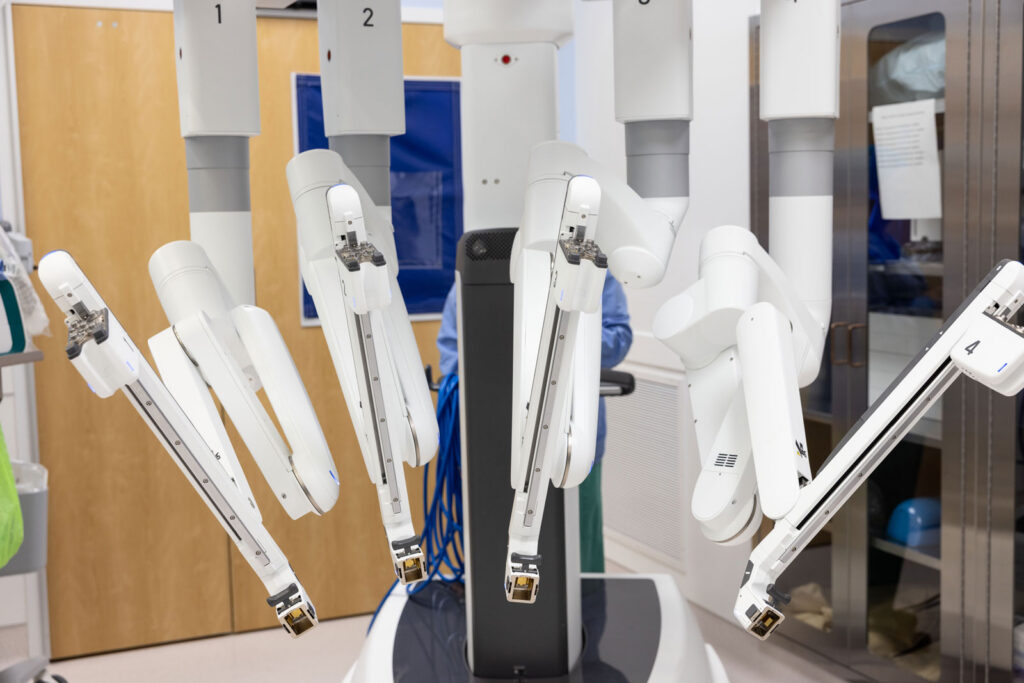
Pediatric surgeons are increasingly turning to robotic technology for the delivery of safe and enhanced minimally invasive surgical approaches for younger children.
Over the past two decades, the use of minimally invasive surgery (MIS) techniques for both laparoscopic and thoracoscopic surgery have been widely adopted for the treatment of children requiring various surgical procedures. This approach has become the mainstay for young patients requiring a number of commonly performed abdominal procedures, including cholecystectomy (removal of the gallbladder) or appendectomy. An expanding body of literature has recently shown that robotic-assisted surgery is emerging as a safe and effective alternative to traditional MIS; one that may offer advantages in visualization and ergonomics, and even improved cosmesis for children and adolescents, according to a study by Holden W. Richards, et al, published in 2020.
Technical Advantages
Robotic systems offer surgeons several key benefits over standard MIS approaches, including three-dimensional high-fidelity imaging, surgeon tremor filtration and wristed instruments that improve dexterity in small or difficult-to-access anatomic spaces. Additionally, single-site robotic approaches also reduce technical limitations common to single-site laparoscopy, such as instrument collisions and poor ergonomics, while offering a cosmetic benefit as a result of a reduced number of required surgical incisions.
“Traditional laparoscopy can feel like operating with chopsticks,” explains Marc Michalsky, MD, MBA, a pediatric surgeon and director of the Center for Robotic Surgery at Nationwide Children’s Hospital. “Robotics gives us greater range of motion, enhanced imaging and steadier instrument control, which is especially helpful in certain procedures”.
Whether these technical advantages translate into measurable clinical benefits for patients remains an open question and the focus of ongoing reach at Nationwide Children’s and elsewhere.
Comparable Outcomes
A recent study led by Dr. Michalsky’s team at Nationwide Children’s compared robotic-assisted cholecystectomy (RA-C) with traditional laparoscopic cholecystectomy (Lap-C) in children admitted for acute cholecystitis. The results showed no significant differences in operative times, length of hospital stay or 30-day complication rates between the two groups. The study was published in the Journal of Laparoendoscopy & Advanced Surgical Techniques.
That finding is critical as it demonstrates that robotic surgery can be used safely, even in urgent inpatient settings where related clinical reports have historically been scarce.
“Our data show that robotic surgery is just as safe as laparoscopy, even in acute cases,” says Dr. Michalsky, who was senior author of the study. “That gives families confidence that we can offer robotic approaches not only for elective operations but also when children need urgent care.”
Expanding Applications
At Nationwide Children’s, the robotic approach is increasingly being applied not only to cholecystectomy but also to appendectomy and numerous other general and thoracic pediatric surgeries for children and adolescents. These cases highlight the system’s versatility and potential to become a new standard for minimally invasive pediatric surgery in the future.
“Parents value the cosmetic outcome of a single hidden incision,” says Dr. Michalsky, who is also a professor of Clinical Surgery and Pediatrics at The Ohio State University College of Medicine. “For children, it often means less discomfort and a smoother recovery.”
Looking Ahead
While barriers to routine use, such as the need for trained operating room teams and cost considerations remain, Nationwide Children’s and similar institutions are demonstrating that robotic-assisted pediatric surgery can be both feasible and effective in both elective and acute surgical care.
As more hospitals gain access to robotic systems and as surgical teams become proficient in their use, the technology is poised to expand beyond elective cases to urgent and potentially event emergent scenarios.
“Robotics technology is continually evolving,” Dr. Michalsky notes. “We anticipate further advances in miniaturization and integration with imaging and data systems. In the future, many pediatric surgeries may be performed robotically, and we want to be at the forefront of that progress.”
References:
- Richards HW, Kulaylat AN, Cooper JN, McLeod DJ, Diefenbach KA, Michalsky MP. Trends in robotic surgery utilization across tertiary children’s hospitals in the United States. Surgical Endoscopy. 2021 Nov;35(11):6066-6072.
- Svetanoff WJ, Diefenbach K, Aldrink JH, Michalsky MP. Robotic-Assisted Versus Laparoscopic Approach for Treatment of Acute Cholecystitis in Children. J Laparoendosc Adv Surg Tech A. 2024 Dec;34(12):1134-1139.
Image credit: Nationwide Children’s
About the author

Lauren Dembeck, PhD, is a freelance science and medical writer based in New York City. She completed her BS in biology and BA in foreign languages at West Virginia University. Dr. Dembeck studied the genetic basis of natural variation in complex traits for her doctorate in genetics at North Carolina State University. She then conducted postdoctoral research on the formation and regulation of neuronal circuits at the Okinawa Institute of Science and Technology in Japan.
- Lauren Dembeckhttps://pediatricsnationwide.org/author/lauren-dembeck/

- Lauren Dembeckhttps://pediatricsnationwide.org/author/lauren-dembeck/
- Lauren Dembeckhttps://pediatricsnationwide.org/author/lauren-dembeck/

- Lauren Dembeckhttps://pediatricsnationwide.org/author/lauren-dembeck/