
High Rates of Readmission and Airway Complications Found in Tracheostomy-Dependent Infants With BPD
High Rates of Readmission and Airway Complications Found in Tracheostomy-Dependent Infants With BPD https://pediatricsnationwide.org/wp-content/uploads/2020/04/DSC_0635_HRBW.gif-BPD-header-1024x575.gif 1024 575 Lauren Dembeck https://pediatricsnationwide.org/wp-content/uploads/2021/03/Dembeck_headshot.gif
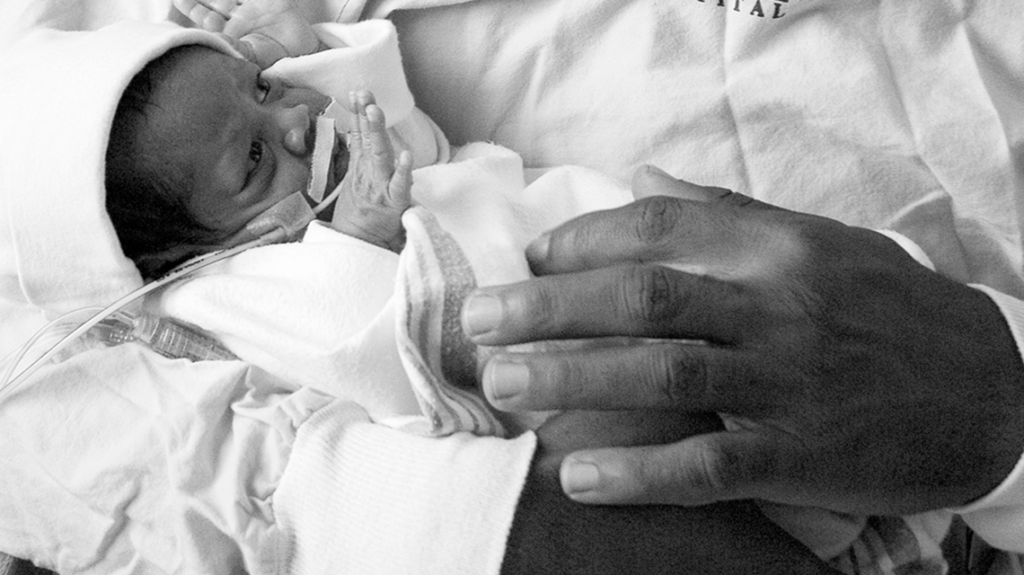
While tracheostomy can be lifesaving for infants with severe bronchopulmonary dysplasia, new data highlights the risks and outcomes that families and providers must be prepared to face.
Infants with bronchopulmonary dysplasia (BPD), the most common morbidity of prematurity, often require long-term respiratory support. Severe BPD can necessitate tracheostomy that is often paired with mechanical ventilation, and while sometimes lifesaving, tracheostomy is associated with potential complications, including accidental decannulation, wound issues and developmental delays. The decision to perform a tracheostomy in infants with severe BPD is complex, with varying practices among institutions. The Comprehensive Center for Bronchopulmonary Dysplasia at Nationwide Children’s has created a Trach Scoring Tool to help parents and providers manage the difficult decision of moving forward with tracheostomy.
“At Nationwide Children’s, we take a tracheostomy-avoidant approach,” says Tendy Chiang, MD, pediatric otolaryngologist and associate program director of the Pediatric Otolaryngology Fellowship Program at Nationwide Children’s Hospital. “We typically reserve tracheostomy placement for older infants who have failed multiple extubation attempts or are unable to transition to lower levels of respiratory support after numerous efforts. In some cases, a tracheostomy is required for a structural airway anomaly, not just parenchymal lung disease like BPD. As a result, our overall tracheostomy rate across our unit is only about 4%, which is quite low.”
With the improved overall survival due to advances in clinical management, the population of tracheostomy‐dependent infants with BPD is increasing. However, data on tracheostomy outcomes are limited.
“We’re saving more babies at earlier gestational ages than ever before,” says Audrey Miller, MD, attending neonatologist at Nationwide Children’s and assistant professor at The Ohio State University. “Ten years ago, infants born at 22, 23 or even 24 weeks’ gestation often didn’t survive, so we didn’t see as many complications of extreme prematurity. But as neonatal care has improved and survival rates for extremely premature infants have increased, we’re now seeing more long-term complications in these babies, with BPD being the most common one.”
In a new publication in Pediatric Otolaryngology, Drs. Chiang and Miller along with colleagues at Nationwide Children’s report tracheostomy-related outcomes, including morbidity and mortality, readmissions and airway interventions, in tracheostomy-dependent children with BPD.
The retrospective chart review included 76 infants with BPD who received tracheostomy at Nationwide Children’s between January 2016 and December 2022. Patients were followed until at least 2 years of age.
In this cohort, the overall mortality rate was 30.3%, and 78% of these patients died during the primary admission, most commonly from severe BPD with subsequent withdraw of care. Tracheostomies were typically placed at a median postmenstrual age of 56 weeks. Tracheitis emerged as the most frequent complication, occurring in 21% of patients within the first postoperative week and in 81% beyond the first week. Other common complications included stomal granuloma (77%), airway stenosis (69%) and accidental decannulation (38%).
The study found high rates of tracheostomy-related hospital readmissions, with 30-day and 2-year readmission rates of 32% and 61%, respectively, with tracheitis being the leading cause of readmission. Among survivors, 68% were successfully decannulated at a median age of 3.1 years, though most (85%) required additional operative airway procedures, including open airway reconstruction in 43% of cases.
“I think there’s sometimes a perception among parents that once a tracheostomy is placed, the disease process with stabilize and the patient will be heading towards discharge home,” says Dr. Miller, who is also the medical director of the inpatient BPD unit at Nationwide Children’s. “But the morbidities we identified in this study are incredibly important to highlight, and I now routinely use this data when counseling families who are facing the decision about tracheostomy. It’s crucial that we help parents understand that this is a long journey.”
“There are very real risks — readmissions are common, tracheitis is likely, and many children will need airway reconstruction. Children with tracheostomy often have delayed development as well,” adds Dr. Chiang. “I agree that we can do a better job of preparing families for what lies ahead and giving them a realistic picture of the challenges they may face.”
“Additionally, tracheostomy only changes the airway, not the underlying disease,” continues Dr. Chiang. “Children with bronchopulmonary dysplasia have cellular changes in their airway that could be impacting their respiratory function. If we can understand these changes, we might be able to develop targeted therapies to improve mucus clearance and reduce complications.”
Reference
Sher AC, Shamim H, Maynard J, Stack J, Kistler I, McNutt M, Afreen H, Manning A, Miller A, Pattisapu P, Chiang T. Tracheostomy outcomes in children with bronchopulmonary dysplasia. Otolaryngol Head Neck Surg. 2025 Apr 10. doi: 10.1002/ohn.1248. Epub ahead of print.
Image credit: Nationwide Children’s
About the author

Lauren Dembeck, PhD, is a freelance science and medical writer based in New York City. She completed her BS in biology and BA in foreign languages at West Virginia University. Dr. Dembeck studied the genetic basis of natural variation in complex traits for her doctorate in genetics at North Carolina State University. She then conducted postdoctoral research on the formation and regulation of neuronal circuits at the Okinawa Institute of Science and Technology in Japan.
- Lauren Dembeckhttps://pediatricsnationwide.org/author/lauren-dembeck/

- Lauren Dembeckhttps://pediatricsnationwide.org/author/lauren-dembeck/
- Lauren Dembeckhttps://pediatricsnationwide.org/author/lauren-dembeck/
- Lauren Dembeckhttps://pediatricsnationwide.org/author/lauren-dembeck/