
Hip Ultrasound Has Clinical Utility in Detecting Developmental Dysplasia of the Hip Among Preterm Infants
Hip Ultrasound Has Clinical Utility in Detecting Developmental Dysplasia of the Hip Among Preterm Infants https://pediatricsnationwide.org/wp-content/uploads/2021/01/013019BS2257_c._header-1024x575.jpg 1024 575 Jessica Nye, PhD https://pediatricsnationwide.org/wp-content/uploads/2021/09/JNye_glasses.png
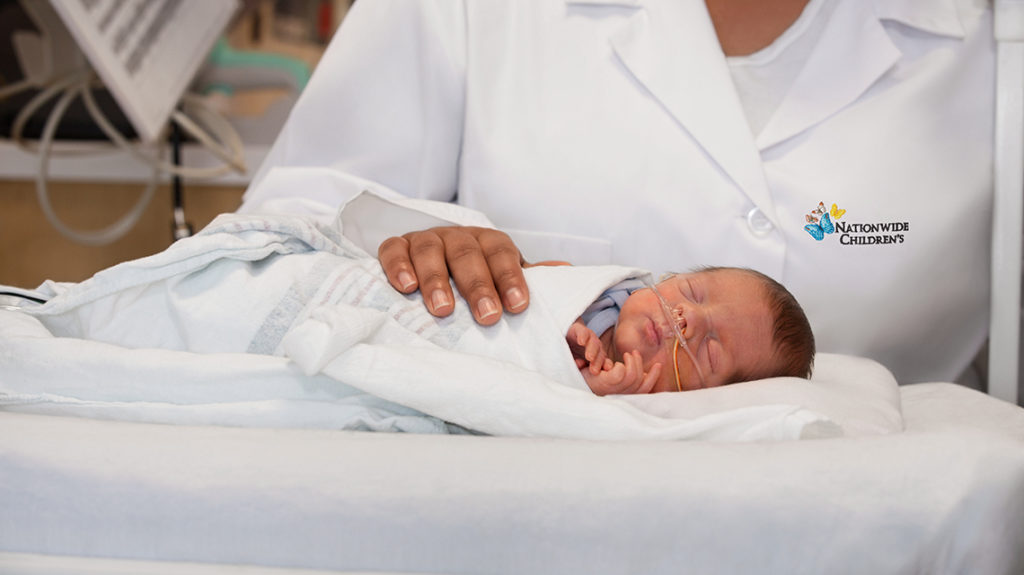
A positive first hip ultrasound (HUS) is highly predictive of having developmental dysplasia of the hip (DDH) among preterm infants, according to results of a study published in the American Journal of Perinatology.
“In term babies, more is known about the accuracy of ultrasounds for congenital or developmental hip dysplasia. But in preterm babies, there are very little data,” says Jonathan L. Slaughter, MD, MPH, a neonatologist and principal investigator in the Center for Perinatal Research at Nationwide Children’s Hospital and a Professor of Pediatrics and Epidemiology at The Ohio State University. He is the senior author of the study.
“The motivation behind the study is the observation that so many preterm infants undergo this HUS test because of breech presentation at birth, when there are uncertainties about their risk of DDH. This is done because national guidelines recommend HUS for breech presentation based on research done in term infants showing increased risk of DDH with breech presentation. Preterm infants are much more likely to have breech presentation at birth, hence more likely to have HUS that might lead to visits to specialists and follow up imaging when their risk of DDH is lower,” says Ahmed Osman, MD, a neonatologist at Nationwide Children’s and lead author of the study.
To test the accuracy of HUS for diagnosing DDH in prematurity, infants (N=2397) who were born before 37 weeks’ gestation between 2009 and 2018 at Nationwide Children’s and who underwent HUS during their first year of life were evaluated for DDH diagnosis and treatment.
The children with (n=71) and without (n=2,326) DDH comprised 66% and 50% girls, 84% and 72% were White, 77% and 54% were born at 32 to 36 weeks’ gestation and they had a median birthweight of 2,347 and 1,697 grams, respectively.
Overall, most first HUS results were normal (89%). On average, 80% of the time that HUS shows an abnormality, the infant is ultimately diagnosed with DDH, and 99% of the time when the HUS is normal, the baby does not have DDH.
“I was reassured by these findings. We found that hip ultrasound is accurate at determining which babies likely have the disease and need referral to orthopedic experts for follow-up. As a screening test, it is very unlikely to miss babies with DDH. That’s the hope. We would be worried if we found different results. It’s really reassuring,” says Dr. Slaughter.
Most infants with DDH were diagnosed with bilateral dysplasia (54%).
The primary DDH treatment approach was Pavlik harness (58%), and most patients (78%) initiated treatment on the day of diagnosis. More than a third of patients (36%) underwent surgical correction for hip dysplasia and 29% who were treated with Pavlik harness ultimately underwent surgical correction.
Dr. Osman concludes, “DDH affects walking in children and leads to disability in adults, it is important to recognize and treat it early. Universal physical exam of the hips in infants is the primary methods of screen for DDH. HUS is an additional tool for infants at higher risk. This study shows that we are timely diagnosing and treating preterm infants with this condition.”
Reference:
Osman A, Conroy S, Slaughter JL. Relationship between hip ultrasound result and diagnosis of developmental dysplasia of the hip in premature infants. Am J Perinatol. Published online May 8, 2025.
Image credit: Nationwide Children’s
About the author

Jessica Nye, PhD, is a freelance science and medical writer based in Barcelona, Spain. She completed her BS in biology and chemistry and MS in evolutionary biology at Florida State University. Dr. Nye studied population genetics for her doctorate in biomedicine at University of Pompeu Fabra. She conducted her postdoctoral research on the inheritance of complex traits at the Autonomous University of Barcelona.
- Jessica Nye, PhDhttps://pediatricsnationwide.org/author/jessica-nye-phd/

- Jessica Nye, PhDhttps://pediatricsnationwide.org/author/jessica-nye-phd/

- Jessica Nye, PhDhttps://pediatricsnationwide.org/author/jessica-nye-phd/
- Jessica Nye, PhDhttps://pediatricsnationwide.org/author/jessica-nye-phd/