
Rethinking Neonatal HSV Management: A Less Aggressive, Evidence-Informed Approach
Rethinking Neonatal HSV Management: A Less Aggressive, Evidence-Informed Approach https://pediatricsnationwide.org/wp-content/uploads/2025/11/AdobeStock_40952832-crop-for-web-1024x593.jpg 1024 593 Alaina Doklovic https://pediatricsnationwide.org/wp-content/uploads/2023/11/100923RH0019-e1699635391623.jpg

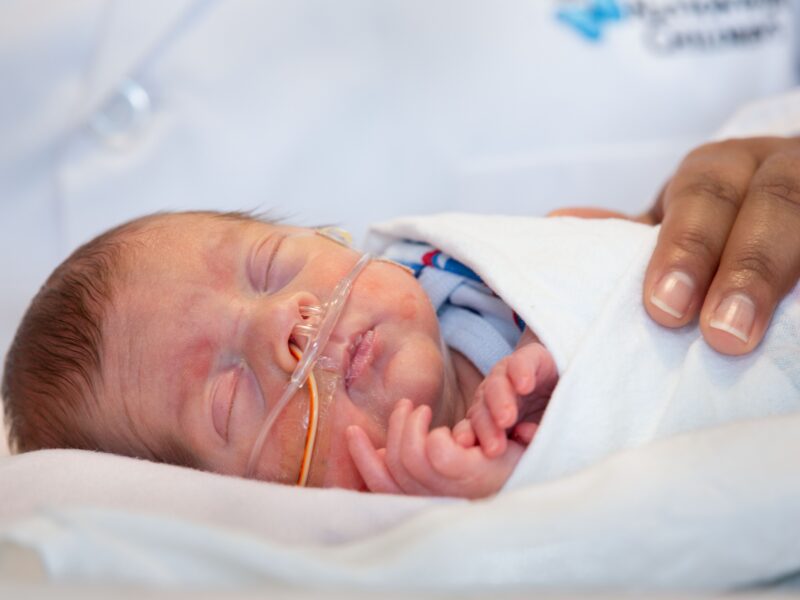
An alternative approach to neonatal HSV management helps keep mom and baby together during the nursery stay.
Neonatal herpes simplex virus infection (HSV) is a rare but often fatal disease when not treated correctly or in a timely manner. This makes diagnosis and preventive strategies extremely important when expectant mothers have active genital HSV infection when they deliver.
Neonatal HSV is a result of vertical transmission from mother to newborn and most often occurs intrapartum, as the infant is exposed to and delivered through the infected birth canal. There is still a risk of transmission during cesarean sections (c-sections) especially after 4 or more hours of membrane rupture.
Because of this unique susceptibility and severity, the American Academy of Pediatrics (AAP) developed guidelines that recommends testing of all newborns delivered to mothers with active genital HSV lesions and provision of antiviral therapy to some higher risk newborns. The management of asymptomatic neonates is dependent on whether the mother is experiencing a primary or recurrent infection.
“While the AAP algorithm is reliable, they don’t take into account the importance of the early bonding between mother and baby as the infant often requires admission to the neonatal intensive care unit for assessment and management. In addition, it does not address the issues dealing with prolonged intravenous access and assessment of perinatal risk factors,” says Pablo Sánchez, MD, neonatologist and pediatric infectious disease specialist, and principal investigator in the Center for Perinatal Research at the Abigail Wexner Research Institute at Nationwide Children’s Hospital. “The guidelines are overly aggressive, and that approach may not be necessary for every infant and family.”
In a recent review, Dr. Sánchez highlights an alternative approach to the AAP guidelines, which have been utilized for 25 years at Parkland Hospital in Dallas, Texas, and has since been implemented and continued at Nationwide Children’s Hospital, The Ohio State University Wexner Medical Center, and other birthing hospitals in Columbus, Ohio since 2014. Dr. Sánchez developed this alternative protocol at a time where there was little to no guidance on the management and treatment of babies born to mothers who have active genital HSV lesions.
The biggest difference between the alternative approach and the AAP guidelines is the aggressive evaluation and overuse of acyclovir therapy. The current AAP guidelines recommend preemptive antiviral therapy with intravenous acyclovir, which often consists of a 10-day treatment if the mother has a primary infection at delivery or in the third trimester. This is given even if the baby tests negative for HSV if the mother is experiencing a primary HSV infection. Per AAP guidelines, the evaluation of these well newborns also includes a lumbar puncture when HSV PCR and HSV type-specific serologic testing is available with short turnaround times for results. Otherwise, this approach has limited, if any, applicability. The alternative guidelines proposed by Dr. Sánchez is more practical as it can be universally adopted even in setting with limited access to type-specific maternal serologic testing.
“Even with a negative test, the recommendation is 10 days of IV acyclovir therapy,” says Dr. Sánchez. “That’s 10 days those babies are in the NICU, 10 days they are away from their mothers, and 10 days they are in the hospital longer than they may need to be. I’m concerned that it’s causing more harm than good. So, we need some acyclovir stewardship, and that’s where the alternative approach comes into play.”
With the alternative approach, treatment is highly dependent on the type of delivery, the type of maternal infection, and the presence of risk factors such as prematurity, scalp electrode or skin lacerations that may facilitate transmission to the newborn. With these key factors in mind, infants can be managed in a more rational basis using highly sensitive HSV PCR testing to exclude neonatal infection.
It is important to note that current guidelines will likely not identify or prevent most neonatal HSV infections, says Dr. Sánchez, adding that research efforts should focus on identification of women who unknowingly are shedding HSV at delivery. He also recommends neonatal HSV infection become a reportable condition in the United States to best understand its prevalence, morbidity and mortality and ultimately inform its prevention.
Dr. Sánchez hopes this review “provides rational and well-informed guidance on the management of neonatal HSV to not only improve neonatal outcomes but also to provide a less aggressive approach that reduces risk, cost and separation between mother and baby.”
Reference:
Sánchez PJ, White NO, Graf RJ, Taveras J. Management of neonates born to mothers with active genital herpes simplex virus infection: an alternative approach. Current Opinions in Infectious Disease. 2025 Oct 1;38(5):443-449. doi: 10.1097/QCO.0000000000001129. Epub 2025 Jul 23.
Image credit: Adobe Stock
About the author

Alaina Doklovic is a Marketing Specialist for Research Communications at Nationwide Children’s Hospital. She received her BS in medical anthropology and English from The Ohio State University. Her passions for science and health, combined with her desire to help others, motivated her to pursue a career in which she could actively help improve patient outcomes and scientific research through writing.
- Alaina Doklovichttps://pediatricsnationwide.org/author/alaina-doklovic/

- Alaina Doklovichttps://pediatricsnationwide.org/author/alaina-doklovic/
- Alaina Doklovichttps://pediatricsnationwide.org/author/alaina-doklovic/
- Alaina Doklovichttps://pediatricsnationwide.org/author/alaina-doklovic/