

Enhanced IV Line Clamp: A New Spin on a Classic
Enhanced IV Line Clamp: A New Spin on a Classic https://pediatricsnationwide.org/wp-content/uploads/2025/09/Original_hi_res_JPG-042525SK0340_Color-1024x683.jpg 1024 683 Madison Storm https://pediatricsnationwide.org/wp-content/uploads/2023/09/092023BT159.png

Revolutionizing patient care through human-centered design
The IV line clamp is a long-standing technology used to deliver intravenous medications and fluids. For over 90 years, the simplistic, gravity-based design has remained unchanged, despite the growing complexity of patient care and significant advancements in medical technology.
Enter Jenna Merandi, PharmD, MS, CCPS, medication safety officer, and Erin Ahrens, BSN, RN, senior solutions developer at Nationwide Children’s Hospital.
Dr. Merandi and Ahrens work with interdisciplinary teams to develop system-based solutions to mitigate risk and prevent errors in eff ort to enhance patient safety.
“Patients we serve have complex needs. For instance, a critically ill infant may require the support of many devices, including smart infusion pumps. These pumps may be delivering life-sustaining medications,” Dr. Merandi says. “If an IV line is inadvertently clamped while a medication is being delivered, that means the medication doesn’t reach the patient. This could lead to potential harm or even fatality if left unnoticed.”
About 80% of hospitalized patients receive intravenous therapy. Over the past several years, reported safety events continue to rise involving inadvertent clamped lines, which have led Dr. Merandi and Ahrens to take a closer look at the medication administration process and the technology. It is important to understand how people interact with technology in fast-paced, high-stress environments.
“We realized there’s a lack of visual cues; nothing that says whether it’s on or off,” Ahrens says.
Enhancing the Design
Dr. Merandi and Ahrens secured support from Nationwide Children’s Office of Technology Commercialization – Technology Development Fund to begin their project. They launched a four-phase enhancement project, guided by human-centered design which included: context immersion, concept development, functional prototyping and comparative usability testing.
“Human-centered design refers to focusing on the actual needs and challenges faced by frontline staff, so that solutions can be more effective and sustainable,” says Ahrens. “It requires understanding workflows, environmental pressures and the cognitive demands placed on frontline staff.”
Dr. Merandi and Ahrens partnered with Priority Designs, a Columbus-based firm specializing in human factors and product development. Together, they conducted on-site clinical observations, engaged directly with nurses, and studied how current IV clamps are used in practice.
“We weren’t looking to add complexity or overhaul bedside workflows,” says Dr. Merandi. “We want to enhance safety by making the clamp’s open and closed status clear — visually and intuitively — without disrupting existing processes.”
Co-designing Safer Solutions
The team developed five early design concepts focused on visibility, intuitive use and that offered unique elements for error prevention. Three designs were selected for prototyping based on how well the technology design emulated the concepts Dr. Merandi and Ahrens were looking for.
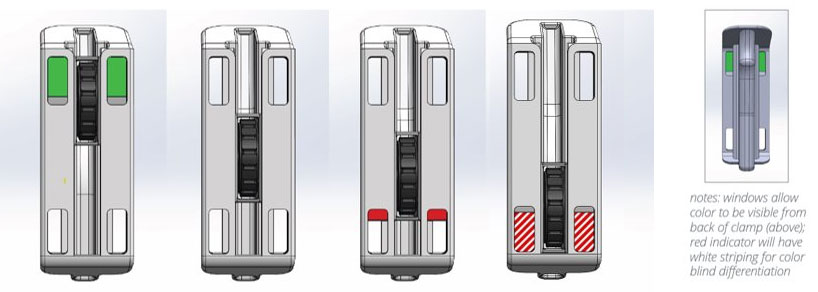
- Concept C retained the familiar wheel-based design of the roller clamp yet emphasized the open and closed position of the clamp with high-contrast color blocking. Similar to the common roller clamp, movement of the wheel from the top to the bottom occurs on a gradient by which the fluid gradually ceases to flow once the clamp is in the fully closed position.
- Concept W incorporated tactile feedback, with a noticeable ‘pop’ confirming when the clamp is fully open.
- Concept S introduced a switch-style clamp that functions intuitively and has a bold visual indicator for clamp status.
All prototypes integrated colored visual cues indicating the open/closed status — one of several features informed by direct clinician feedback.

Comparative Usability Testing
With the prototypes developed, Dr. Merandi and Ahrens hosted human factors engineers from Priority Designs to conduct usability testing in Nationwide Children’s Simulation Center.
“We brought in frontline users from a variety of clinical roles that interact with IV lines, clamps and infusion pumps on a daily basis to look and test the different prototypes,” Ahrens says. “We created realistic clinical scenarios and asked users to interact with the prototypes as they would in real life. Their feedback wasn’t just helpful in our product development — it was essential.”
Three activities that simulated what a user would experience in a clinical environment were monitored and studied by the engineers. Questions were asked throughout, garnering participant assessment of the clamps functionality when operating the clamp and how the open/close status was visualized.
Feedback in Effect
After completing usability testing, the data for each prototype was collected and evaluated using a scoring system relevant to each of the testing activities. Clamp Concept C emerged as the preferred design. Moreover, results revealed that two of the concept prototypes outperformed the current/standard roller clamp.
“In addition to our three concepts, we included the current clamp being today within our prototype testing,” explains Dr. Merandi. “It scored below two of the improved prototypes. That told us the nurses believe in the enhanced design; they believe in the value of the enhanced IV line clamp.”
Refining the Design
With Clamp Concept C selected as the most favored, the team continued to refine the design based on user feedback. This included the following changes to design addressing:
- Visual indicators accessible to individuals with colorblindness
- Clear, unmistakable wheel placement indicating clamp status
- Enhanced visibility from multiple angles and distances
The final product incorporates feedback from user testing, improved usability and an enhanced design. The human-centered design features prominent visual cues, such as open/close status visibility, and inherent function and movement.
As the enhanced IV line clamp moves toward commercialization, design and utility patents have been filed with the help of the Office of Technology Commercialization. Dr. Merandi and Ahrens are working toward their goal of making the enhanced IV line clamp available for clinical use through industry partnerships.
“Our goal here is really to save lives,” Dr. Merandi says. “We want to tackle patient safety issues through innovative design in hopes of creating technologies that make it easier for frontline staff to do the right thing.”
Enhanced IV Line Clamp Video
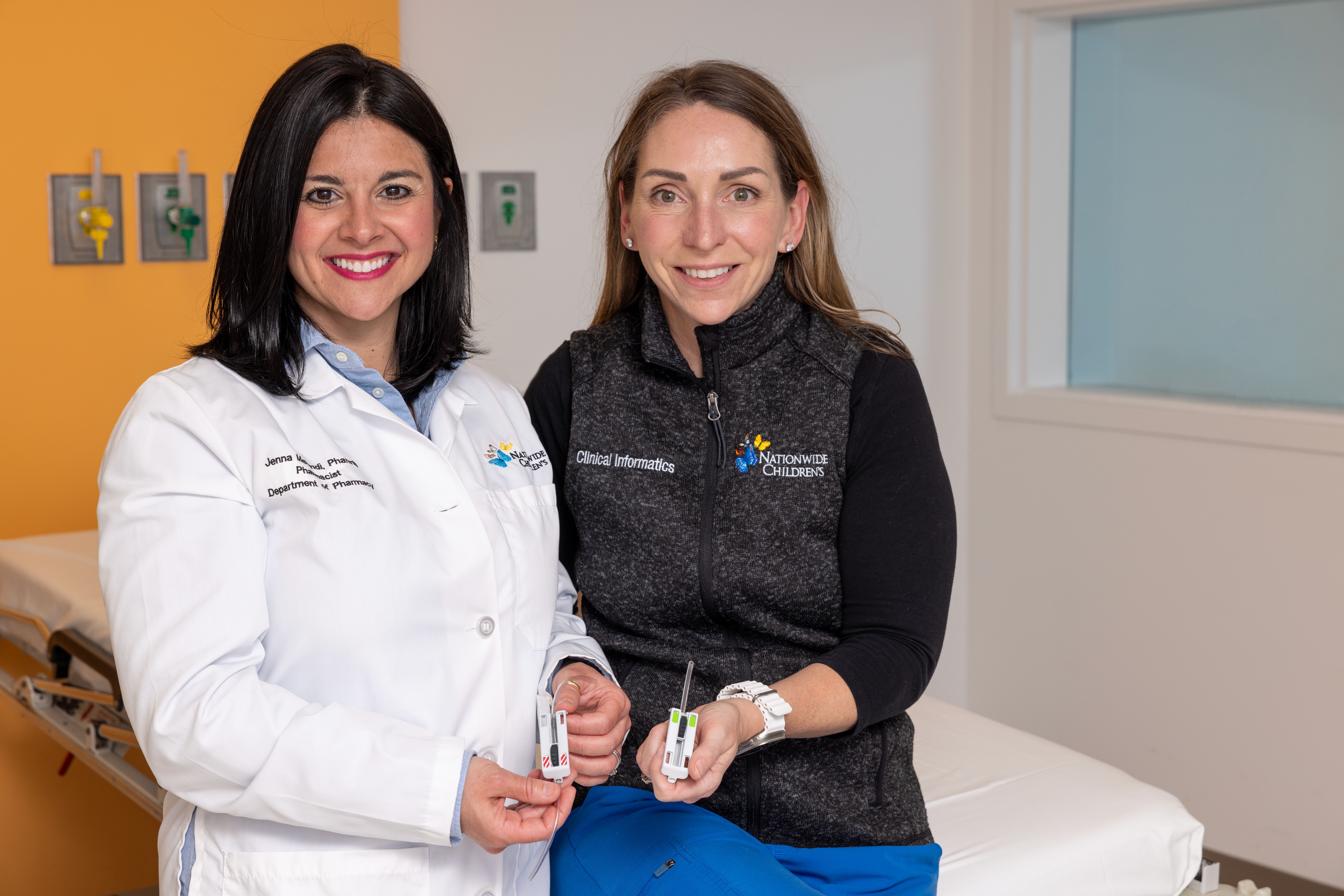
Enhanced IV line clamp inventors Jenna Merandi, PharmD, MS, CPPS (left), and Erin Aherns, BSN, RN (right), are working with the Office of Technology Commercialization at Nationwide Children’s to make their invention available to others through industry partnerships.
Learn more about the Enhanced IV Line Clamp from inventors Jenna Merandi and Erin Aherns.This article appeared in the 2025 Fall/Winter issue. Download the issue here.
About the author

Madison Storm is the Senior Strategist of Research Communications at Nationwide Children's Hospital. She earned her bachelor's in multimedia journalism from Virginia Tech in 2021 and went on to achieve her master's in health communication from Johns Hopkins University in 2023. Her passion for transforming the complex to clear is supported by various experiences writing for consumer audiences.
- Madison Stormhttps://pediatricsnationwide.org/author/madison-storm/

- Madison Stormhttps://pediatricsnationwide.org/author/madison-storm/
- Madison Stormhttps://pediatricsnationwide.org/author/madison-storm/

- Madison Stormhttps://pediatricsnationwide.org/author/madison-storm/