

Meet Our Expert: Albert Isaacs, MD, PhD, Neurosurgeon and Genomic Scientist
Meet Our Expert: Albert Isaacs, MD, PhD, Neurosurgeon and Genomic Scientist https://pediatricsnationwide.org/wp-content/uploads/2025/06/Isaacs_BW_FOR-REFERENCE-ONLY_2.jpg 864 576 Lauren Dembeck https://pediatricsnationwide.org/wp-content/uploads/2021/03/Dembeck_headshot.gif
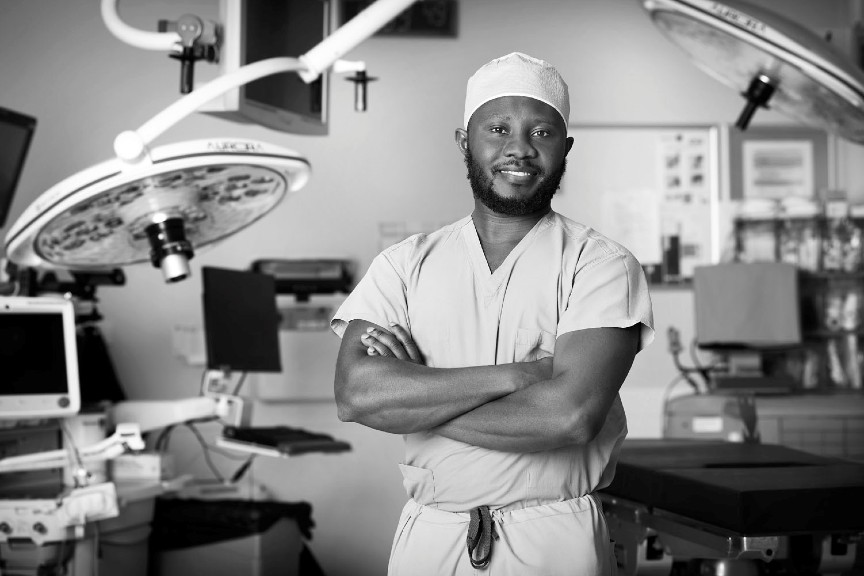
Albert Isaacs, MD, PhD, is a pediatric neurosurgeon at Nationwide Children’s Hospital and an assistant professor of Neurological Surgery at The Ohio State University College of Medicine. His research focuses on uncovering the molecular and immunologic drivers of neonatal hydrocephalus, with the goal of developing preventative treatments for at-risk infants. Dr. Isaacs’ extensive background and training across various institutions and countries reflect his unyielding commitment to excellence and dedication to mentoring the next generation of neurosurgeons.
Read on to learn more about Dr. Isaac’s clinical work and research career.
Why did you decide to pursue a career in medicine, and what was your path to your current role?
My path to medicine began during my undergraduate studies in Ottawa, where I took an introduction to psychology course with a professor I really connected with. He invited me to join his neuroscience lab, and that was my first exposure to research. It was small animal research and made me realize I was more interested in human research directly. I realized pretty early on that what excited me wasn’t just the science itself but applying that knowledge to help people, and that drew me to medicine.
I went on to complete med school in Vancouver and started neurosurgery residency in Calgary. Eventually, that first love of neuroscience research and how research can inform medicine came full circle for me. I felt frustrated by how little we understood about certain devastating pediatric brain conditions. So, in a pretty unconventional move, I stepped out of residency and pursued two PhDs — one in neuroscience and one in biomedical science — at the same time, in Calgary and at WashU in St. Louis because I wanted to be able to address these questions using a scientific approach. After that, I returned to finish my neurosurgery residency and then completed a pediatric neurosurgery fellowship at Vanderbilt. I was recruited to Nationwide Children’s toward the end of my fellowship.
Why did you decide to pursue your work at Nationwide Children’s Hospital?
I was interviewing at a number of great places, including an offer to return to where I trained, but what Nationwide Children’s offered stood out. In my conversations with my current chief Jeffrey Leonard, MD, it was clear he was willing to fully support me as an early-stage investigator and neurosurgeon. I’d have the opportunity to do the surgeries I love, build a niche practice focused on the patients I’m most passionate about, and fully integrate my clinical work with my lab.
On top of that, the genomic research infrastructure here is unmatched. I don’t think there’s another center in the country that compares. That combination really made the decision easy.
You are a neurosurgeon, but your lab is in the Steve and Cindy Rasmussen Institute for Genomic Medicine at Nationwide Children’s. Can you share why that’s the case?
Back in grad school, I was among the first to combine genomics with proteomics — a field now called proteogenomics — to study cerebrospinal fluid (CSF) in high-risk pediatric hydrocephalus. So when I was looking to branch out as an independent investigator, I wanted a place where I could accelerate my genetics research. The Institute here was the best fit and an added benefit is that a handful of my colleagues and mentors from WashU had come here as well.
I’m one of two neurosurgeons in the Institute for Genomic Medicine. It works really well for me. I talk to my patients and their families about the research we’re doing, and many are happy to contribute. We collect CSF during surgery, which would normally be discarded, and use it for our studies. It’s been a great way to integrate clinical care with the research I care deeply about.
Your research is focused on hydrocephalus. How did your interest in hydrocephalus develop, and what are the major unmet needs in the field?
Hydrocephalus was first described by Hippocrates and is an ancient term that means “water on the brain.” That’s essentially what it is: too much CSF building up in the brain, creating pressure and impairing function. In babies, that can stop brain growth entirely. We currently have two surgical options, placing a shunt to drain the fluid or creating a new pathway with a camera, but both have about a 50% failure rate within two years. It’s essentially a coin toss, and many of these kids undergo multiple surgeries.
What’s frustrating is that we’re still treating hydrocephalus like a plumbing problem, without addressing the underlying disease and subsequent brain injury. About 70% of affected children go on to develop cerebral palsy. As a young scientist, I was struck by how little we understand the disease despite how long it’s been around. That curiosity led me to WashU for my PhD, where I began exploring the biology behind it.
While hydrocephalus affects all ages, I’m particularly focused on the kind that develops in preterm infants. Up to 50% of babies born before 28 weeks will have a brain hemorrhage, and about half of those go on to develop hydrocephalus — but why only half? My lab is trying to understand what makes one baby susceptible and another resilient. I believe the answers lie in their genes.
Despite its prevalence of about 1 in every 1,000 live births, hydrocephalus is not well known among the general public and is severely underfunded and under-researched. That’s also part of why I came to Nationwide Children’s; they support this kind of work, through infrastructure and funding and through a real commitment to tackling complex pediatric conditions.
You use a variety of advanced techniques to study this hydrocephalus and its progression. What advances or discoveries are you most excited about right now?
We use a combination of genomics and proteomics to study hydrocephalus, which I’ve been working with since grad school. Back then, I focused on proteomics to analyze CSF for protein biomarkers. That gave us insight into the disease at the level of the final products. At the same time, I collaborated with colleagues using RNA sequencing to better understand how gene expression translates into protein-level changes.
Since coming to Nationwide Children’s, we’ve expanded to using more advanced techniques, including single-cell and single-nucleus RNA sequencing, ATAC-seq and spatial transcriptomics, all paired with proteomic validation. This lets us trace the entire cascade — from chromatin accessibility to gene expression to protein outcomes.
What I’m most excited about right now is a recent discovery: We found that the protein GPNMB is upregulated up to fivefold in infants with post-hemorrhagic hydrocephalus (PHH) compared to those with other types. This protein could be a biomarker or even a therapeutic target. We think hydrocephalus is driven by a dysregulated immune response — inflammation that should resolve but doesn’t. GPNMB may play a role in that unresolved inflammation.
I’m also especially excited about using spatial transcriptomics. We can localize that gene in brain tissue and track its expression across development. We’re using normative autopsy tissue from infants through age 18 to map its expression both in health and disease. It’s early but very promising.
What types of studies are you working on to develop personalized treatment for neonatal hydrocephalus?
The idea of personalized treatment for neonatal hydrocephalus really came from a fortunate collaboration when I first arrived at Nationwide Children’s. A colleague had been sequencing NICU patients as part of a feasibility study and had genomic data from approximately 70 infants with hydrocephalus and those without it. That gave us a rich dataset to explore.
We’re finding that the differences may not be in the germline, but more likely in epigenetic changes that influence which babies go on to develop hydrocephalus after hemorrhage. When we got interested in the GPNMB protein, we went back and found six genetic variants in that gene that are associated with susceptibility. So when I talk about personalized medicine, I mean being able to identify risk factors like these and using that knowledge to eventually tailor care or even prevent hydrocephalus from developing in the first place.
We’re not there yet, and with small numbers, it’s hard to draw firm conclusions. But the potential is huge. If we had the funding to routinely sequence the genomes of these kids as part of their care, I believe we could get there. That’s the future we’re working toward.
You are also pioneering the use of CSF as a liquid biopsy for CNS conditions. What are the goals with those types of samples?
Yes, it’s along similar lines. If proteins like GPNMB are truly reliable biomarkers, we can use them to track disease progression or treatment response — ideally through something as minimally invasive as a lumbar puncture, rather than brain surgery.
We’ve already started exploring this. In one case, we had a patient with a rare condition called CNS aggregoma, which is essentially a buildup of deposits in the brain that looks like a tumor, and it kept recurring. After multiple surgeries, we turned to proteomics and genomics to see if we could diagnose and monitor the disease using CSF samples. That work is still ongoing, but it reflects where we’re headed, using CSF liquid biopsies as a less invasive way to diagnose and follow neurological disease.
What continues to give you inspiration or keeps you motivated for your work?
What keeps me going is really my clinical practice — it’s incredibly fulfilling. One area I’m especially excited about is our work with fetoscopic closure of myelomeningoceles, a severe form of spina bifida. Traditionally, we waited until after birth to close the spinal defect, but we now know the third trimester is toxic to exposed nerves, and 80 percent of these babies get hydrocephalus. If we intervene before 25 weeks gestation, we can dramatically improve outcomes, reducing the risk of hydrocephalus by half and preserving motor function.
During my fellowship at Vanderbilt, I trained in open fetal repair, where we’d partially deliver the baby, close the defect, and return the baby to the womb. Here at Nationwide Children’s, we’ve taken it a step further using a fetoscopic approach. We now repair the spine without fully opening the uterus. So far, we’ve completed three of these cases, and the results are promising. It’s less invasive and offers real hope for better neurodevelopmental outcomes.
I’m also passionate about treating children with severe scoliosis, especially those with hydrocephalus-related conditions. These kids often live with significant pain and mobility issues, and correcting their spinal deformities has a huge impact on their quality of life. I do a fair number of brain tumors as well. All of it is challenging, meaningful work, and alongside all that, I stay deeply committed to the science and the research that can change what’s possible.
Fun Facts About Dr. Isaacs
What’s your favorite way to relax?
CrossFit. It’s my go-to for clearing my mind and pushing myself physically, which I find an essential balance to my day.
What’s your book or word and why?
Marcus Aurelius’ Meditations. It’s a timeless guide for resilience, discipline and how to remain humble. The Stoic principles he wrote nearly 2,000 years ago still help me navigate high-stakes decisions with clarity and perspective.
My favorite word is equanimity — the ability to remain calm and composed under stress. It’s something I strive for in every aspect of life.
What’s your favorite band or genre of music?
Vocal jazz. There’s something about the texture of the genre that resonates with me.
What fictional character would you most like to meet and why?
T’Challa / Black Panther. He represents a blend of tradition and progress, strength and humility. As a visionary leader grounded in African heritage, his character resonates with my Ghanaian roots. He shoulders immense responsibility with grace, and his commitment to protecting others while advancing his people’s future is deeply inspiring.
What would be your dream job if you could do anything (that wasn’t working in research)?
Architect. I’m fascinated by the intersection of design, structure and purpose. I’m especially drawn to classical architecture — the kind seen in historic chapels, palaces, and enduring landmarks. There’s something powerful about creating spaces that embody beauty, meaning and legacy.
About the author
Lauren Dembeck, PhD, is a freelance science and medical writer based in New York City. She completed her BS in biology and BA in foreign languages at West Virginia University. Dr. Dembeck studied the genetic basis of natural variation in complex traits for her doctorate in genetics at North Carolina State University. She then conducted postdoctoral research on the formation and regulation of neuronal circuits at the Okinawa Institute of Science and Technology in Japan.
- Lauren Dembeckhttps://pediatricsnationwide.org/author/lauren-dembeck/

- Lauren Dembeckhttps://pediatricsnationwide.org/author/lauren-dembeck/
- Lauren Dembeckhttps://pediatricsnationwide.org/author/lauren-dembeck/

- Lauren Dembeckhttps://pediatricsnationwide.org/author/lauren-dembeck/