

How One Role is Improving Emergency Department Wait Times
How One Role is Improving Emergency Department Wait Times https://pediatricsnationwide.org/wp-content/themes/corpus/images/empty/thumbnail.jpg 150 150 Alaina London https://pediatricsnationwide.org/wp-content/uploads/2023/11/100923RH0019-e1699635391623.jpg
In any emergency department (ED), many people work behind the scenes to keep things running smoothly so patients receive the care they need, when they need it. At Nationwide Children’s Hospital, one behind-the-scenes position is making a big impact: the triage coordinator.
“The role of triage coordinator and the way it works is unique here at Nationwide Children’s,” says Katie King, RN, program manager for the Emergency Department at Nationwide Children’s. “Most EDs don’t have anyone in a role like this. In those that do, the role is functionally different.”
At Nationwide Children’s, the triage coordinator works behind the scenes to manage the flow of the patient assessment area and the patient intake process. They also streamline provider communication to get orders or evaluations quickly, manage patient family concerns and complaints and step in to assess emergent patients when needed.
Nationwide Children’s first implemented the triage coordinator role in the hopes of improving patient wait times and finding solutions to combat the extra strain on patient room availability. There are currently 25 triage coordinators on staff. Depending on the number of triage coordinators available, they usually work from 11 a.m. to 3 a.m. every day to keep the ED running smoothly.
“We are a really busy pediatric emergency department, seeing around 8,000 patients per month, so being creative with the space we have is really important. The triage coordinator has been one of our biggest strengths,” says King.
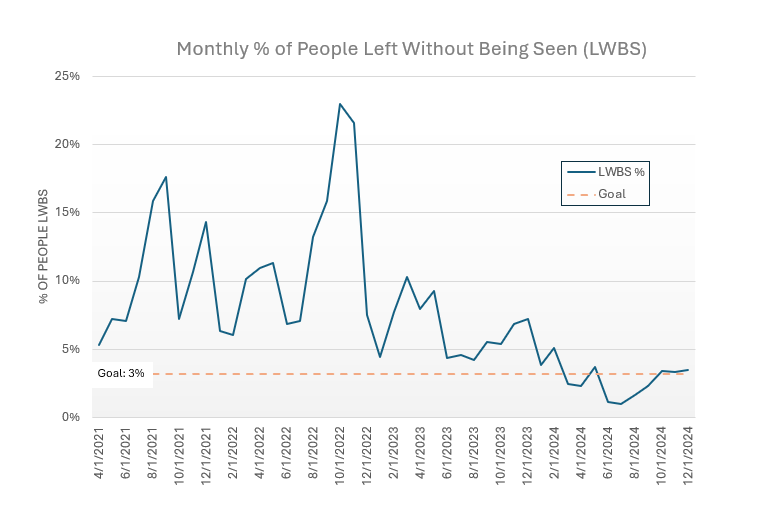
Since the implementation of the triage coordinator in 2023, the overall satisfaction with wait times has improved. Additionally, the left-without-being-seen rates have significantly decreased, meaning more patients are getting the care they need.
The triage coordinator role also provides leadership roles and growth opportunities for the nurses in the ED. This position allows existing internal nurses to grow into a role that teaches communication, organization and leadership skills.
“Working in the emergency department is a team effort,” says Ashley Dunaway, RN, clinical leader in the emergency department at Nationwide Children’s. “The triage coordinator works really closely with the nurses, physicians, patient flow coordinator, triage nurse and everyone else you might not see behind the scenes. Patient care always comes first, so if we can take additional steps to better treat patients, we always will.”
About the author

Alaina London (Doklovic) is a Marketing Specialist for Research Communications at Nationwide Children’s Hospital. She received her BS in medical anthropology and English from The Ohio State University. Her passions for science and health, combined with her desire to help others, motivated her to pursue a career in which she could actively help improve patient outcomes and scientific research through writing.
- Alaina Londonhttps://pediatricsnationwide.org/author/alaina-london/

- Alaina Londonhttps://pediatricsnationwide.org/author/alaina-london/
- Alaina Londonhttps://pediatricsnationwide.org/author/alaina-london/
- Alaina Londonhttps://pediatricsnationwide.org/author/alaina-london/