

Planning Starts During Pregnancy for the Fastest Genome Sequencing in the NICU
Planning Starts During Pregnancy for the Fastest Genome Sequencing in the NICU https://pediatricsnationwide.org/wp-content/uploads/2026/06/Original_hi_res_JPG-013019BS2266-NICU-baby-1024x683.jpg 1024 683 Jessica Nye, PhD https://pediatricsnationwide.org/wp-content/uploads/2021/09/JNye_glasses.png
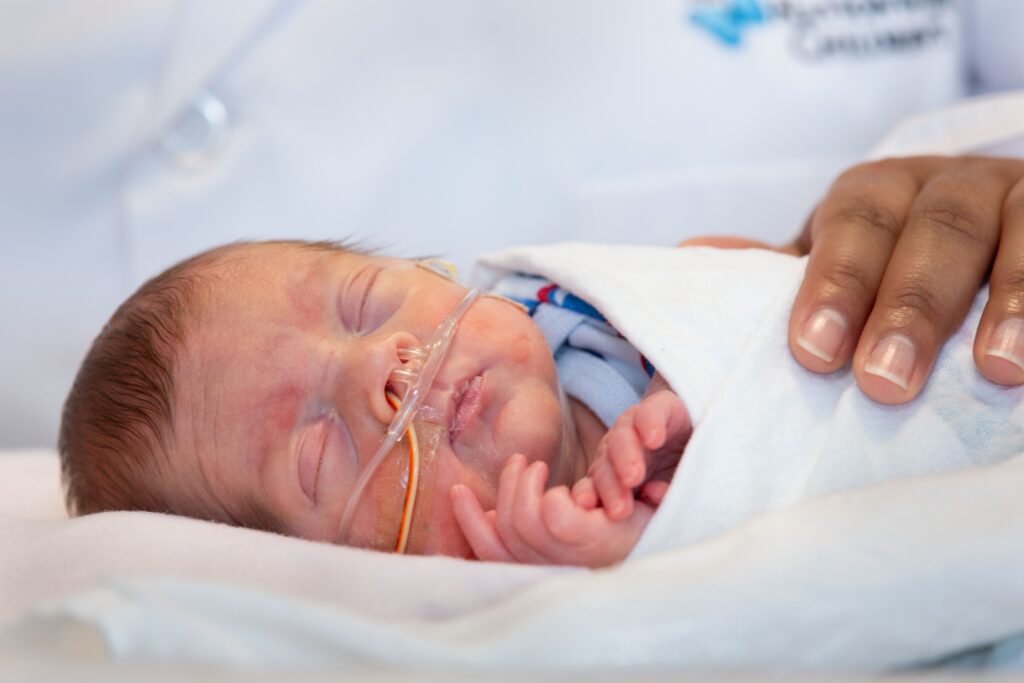
Genome sequencing (GS) has become standard for babies with congenital anomalies in the neonatal intensive care unit (NICU) at Nationwide Children’s.
To ensure that clinicians have access to genomic results as soon as possible, GS coordination is moving to the gestational period for families who are anticipating NICU care after delivery. A commentary about this evolving process was published in Clinical Therapeutics.
“If you rewind to 2018 or 2019, GS in the NICU was considered, in most cases, a second-line test,” says Bimal P. Chaudhari, MD, MPH, associate director of Biomedical Informatics for the Nationwide Children’s and The Ohio State University Clinical and Translational Sciences Institute, attending neonatologist and medical geneticist at Nationwide Children’s, and coauthor of the commentary.
He continues, “I was recruited to the faculty at Nationwide Children’s to bring rapid GS, to develop the relevant infrastructure for a service that could be delivered at scale internally. Now GS has become a standard-of-care test and, since 2024, there’s been increasing effort and thought about ways to expedite access to that testing because it is increasingly recognized that the right time [for GS] is as soon as practical.”
When a fetus is identified as having a severe and potentially life-limiting birth defect, pregnant parents receive initial counseling by maternal fetal medicine (MFM) and pediatric specialists where GS is introduced. In the postnatal setting, parents receive counseling by a genetic counselor from an integrated fetal-neonatal genetics team. At Nationwide Children’s, the postnatal GS testing acceptance rate after prenatal counseling exceeds 90%.

Bimal Chaudhari, MD, MPH
“We understand that the urgency to begin GS collides and conflicts with the realities of having a child who is critically ill. It’s really hard for parents to who are under that degree of stress and worry about their child’s well-being to engage with genetic counselors and think about providing consent for genetic testing,” says Dr. Chaudhari. “There is growing recognition that for the subset of families who know before their child is born that they will require NICU-level care that it may be more feasible to have those discussions while they’re pregnant. If we all know the discussion is going to happen, there’s no reason not to have it. That has a bunch of knock-on benefits related to being able to sample the parents [before delivery].”
Involving the parents in genetic testing can help identify whether de novo mutations or autosomal recessive variant(s) are responsible for the neonate’s condition, effectively streamlining the diagnostic process.
Dr. Chaudhari concludes, “[With access to timely sequencing data], clinicians and families are able to make decisions about their child’s care much faster, which is a big driver of satisfaction. It also prevents unnecessary testing and futile treatments. We’ve also seen access to precision therapies. Everybody wants to talk about precision therapies, but you can’t get a precision therapy if you don’t have a precise diagnosis. We need to do the testing early enough that the precision therapies can still change the child’s life.”
Reference:
Reimers R, Chaudhari BP. The Fastest NICU Genome is One Completed (or at Least Coordinated) Prenatally: A Joint Perspective From United States-Based Maternal-Fetal Medicine and Neonatologist-Geneticists. Clinical Therapeutics. 2026;48(7):588-591.
Image credit: Nationwide Children’s
About the author

Jessica Nye, PhD, is a freelance science and medical writer based in Barcelona, Spain. She completed her BS in biology and chemistry and MS in evolutionary biology at Florida State University. Dr. Nye studied population genetics for her doctorate in biomedicine at University of Pompeu Fabra. She conducted her postdoctoral research on the inheritance of complex traits at the Autonomous University of Barcelona.
- Jessica Nye, PhDhttps://pediatricsnationwide.org/author/jessica-nye-phd/

- Jessica Nye, PhDhttps://pediatricsnationwide.org/author/jessica-nye-phd/
- Jessica Nye, PhDhttps://pediatricsnationwide.org/author/jessica-nye-phd/
- Jessica Nye, PhDhttps://pediatricsnationwide.org/author/jessica-nye-phd/