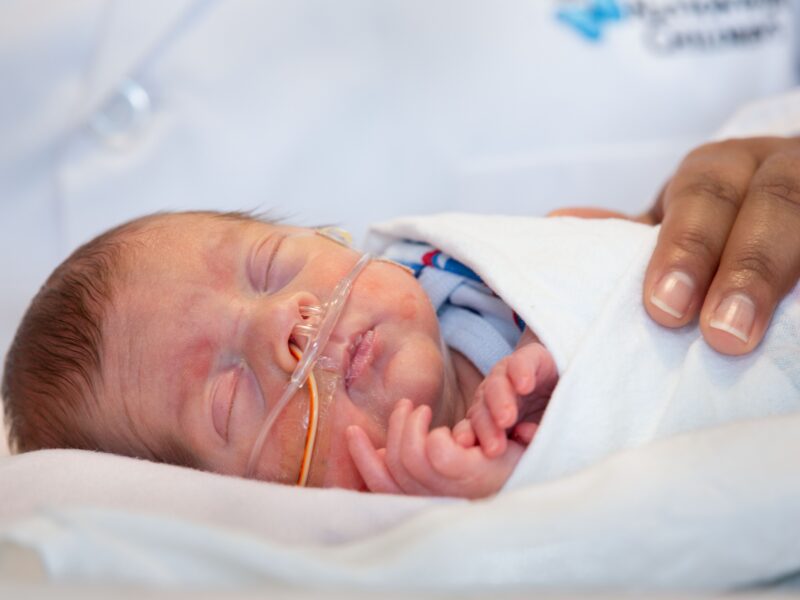

Could Missed Feeding Milestones Be Driving NICU Complications?
Could Missed Feeding Milestones Be Driving NICU Complications? https://pediatricsnationwide.org/wp-content/uploads/2026/04/AdobeStock_106379455_white-for-web-1024x492.jpg 1024 492 Katie Brind'Amour, PhD, MS, CHES https://pediatricsnationwide.org/wp-content/uploads/2021/03/Katie-B-portrait.gif

New research suggests delayed feeding progression may contribute to growth faltering, prolonged hospitalization and other complications in very preterm infants.
For years, clinicians have largely assumed that preterm infants reach feeding milestones later because they are sicker. New research from Nationwide Children’s suggests the relationship may also work in the opposite direction.
Investigators found that very preterm infants who experienced delays in key feeding milestones were more likely to develop postnatal growth faltering (PGF), spend longer periods in the neonatal intensive care unit (NICU) and experience significant comorbidities.
The study, published in the Journal of Perinatology, followed 77 infants born before 32 weeks’ gestation. Researchers examined the relationship between feeding progression, growth trajectories and common NICU complications.
“What was exciting about this study is that we looked backward from discharge,” says Sudarshan Jadcherla, MD, neonatologist and director of the Innovative Infant Feeding Disorders Program at Nationwide Children’s. “We often focus on problems when they become obvious at 36 to 40 weeks’ postmenstrual age and we want to discharge them. But when we examined these infants more closely, we found many had experienced growth faltering and delayed feeding progression much earlier.”
Researchers categorized infants based on growth patterns between birth and discharge. Severe PGF was defined as a decline of more than two weight z-scores, while complex PGF included declines in weight, length and head circumference. Overall, about 34% of infants met criteria for postnatal growth faltering.
Those infants were more likely to experience delays in enteral feeding milestones, including initiation of feeding and achievement of full enteral nutrition. Delayed feeding progression was also associated with longer hospital stays. Infants born before 28 weeks’ gestation, as well as those who experienced complications such as sepsis, intraventricular hemorrhage, bronchopulmonary dysplasia (BPD) and patent ductus arteriosus, were particularly vulnerable.
The findings challenge a common assumption about causality.
“It flips the question on its head,” says Dr. Jadcherla. “These problems precede many classic NICU diagnoses, such as BPD. Rather than asking whether babies miss feeding milestones because they are sicker, we have to consider whether delayed feeding progression may be contributing to later complications.”
The results reinforce what neonatologists have long recognized: nutrition plays a central role in growth and development.
“Many people focus on whether a baby gained weight,” Dr. Jadcherla says. “But growth is much more than that. Length, head growth and the overall growth trajectory are critical indicators of how a baby is developing.”
Researchers found that enteral feeding milestones were more strongly associated with growth outcomes than oral feeding milestones, which are typically introduced later in a more stable phase of hospitalization. According to Dr. Jadcherla, early enteral feeding may help stimulate developmental communication between the gastrointestinal tract and the brain, supporting gut function and the maturation of feeding skills, such as hunger cues, that later enable infants to feed independently.
The findings also highlight the importance of following established feeding protocols.
“Our findings show that feeding progression is closely tied to how well preterm infants grow and how quickly they can be discharged home,” says Faith Bala, PhD, research associate in the Innovative Infant Feeding Disorders Program and first author of the study. “Earlier, targeted advancement of feeding may be an important opportunity to improve outcomes for these vulnerable infants.”
For clinicians, the message is straightforward: existing feeding protocols must be consistently followed.
“Protocols have been developed through years of research,” Dr. Jadcherla says. “Adherence is the key. Earlier recognition of growth faltering, along with appropriate advancement of enteral and oral feeding, might help improve their growth trajectory and shorten hospital stays.”
The research team is now studying strategies to improve protocol adherence and developing individualized approaches for infants who continue to struggle with feeding milestones later in their NICU course. Ultimately, the goal is to promote healthy growth, accelerate feeding development and reduce the need for long-term tube feeding after discharge.
“Hippocrates said diet is the best medicine,” says Dr. Jadcherla. “My version would be this: For these babies, diet — started earlier and provided appropriately through the gut — may be the best medicine.”
Reference:
Bala F, Alshaikh E, Jadcherla SR. Relationship between feeding milestones and comorbidities with the postnatal growth in preterm infants. Journal of Perinatology. Published online June 9, 2026. doi:10.1038/s41372-026-02744-4
About the author

Katherine (Katie) Brind’Amour is a freelance medical and health science writer based in Pennsylvania. She has written about nearly every therapeutic area for patients, doctors and the general public. Dr. Brind’Amour specializes in health literacy and patient education. She completed her BS and MS degrees in Biology at Arizona State University and her PhD in Health Services Management and Policy at The Ohio State University. She is a Certified Health Education Specialist and is interested in health promotion via health programs and the communication of medical information.
- Katie Brind'Amour, PhD, MS, CHEShttps://pediatricsnationwide.org/author/katie-brindamour-phd-ms-ches/

- Katie Brind'Amour, PhD, MS, CHEShttps://pediatricsnationwide.org/author/katie-brindamour-phd-ms-ches/
- Katie Brind'Amour, PhD, MS, CHEShttps://pediatricsnationwide.org/author/katie-brindamour-phd-ms-ches/
- Katie Brind'Amour, PhD, MS, CHEShttps://pediatricsnationwide.org/author/katie-brindamour-phd-ms-ches/