
Setting the Stage the Next Era of Gene Therapy for Ultrarare Disease
Setting the Stage the Next Era of Gene Therapy for Ultrarare Disease https://pediatricsnationwide.org/wp-content/uploads/2025/12/Original_hi_res_JPG-091025SC0110_Color-for-web-1024x576.jpg 1024 576 Abbie Miller https://pediatricsnationwide.org/wp-content/uploads/2023/05/051023BT016-Abbie-Crop.jpg
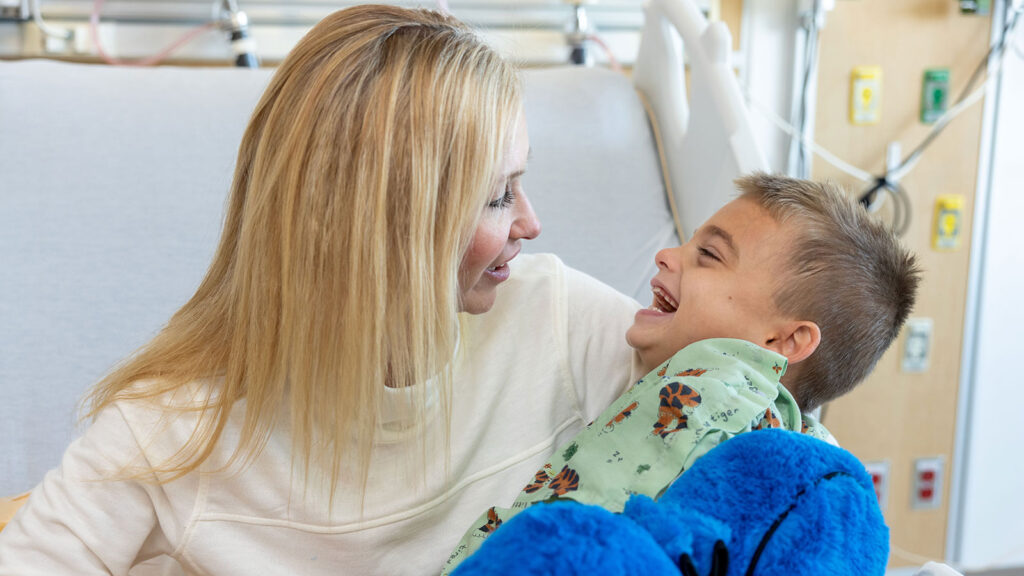
Researchers at Nationwide Children’s Hospital recently administered a novel gene therapy targeting SLC6A1, advancing precision medicine for children who previously could not be treated.
Maxwell, age 8, made history this fall, when he received a bespoke gene therapy targeting his ultrarare disease. This wasn’t the first time he worked with the team at Nationwide Children’s Hospital to advance the science for SLC6A1, however. His mutation helped create the mouse model used to develop the experimental gene therapy. The Maxwell mouse is an instrumental model for SLC6A1 and in the development of a gene therapy.
What is SLC6A1?
Solute carrier family 6 membrane 1 (SLC6A1) protein is a GABA (a type of neurotransmitter) transporter in the plasma membrane that removes GABA from the synaptic cleft, or the space between nerve cells. It is mostly expressed in certain neurons and astrocytes.
Mutations in the SLC6A1 gene can result in SLC6A1-related neurodevelopmental disorder. This disorder is characterized by developmental delays, autism spectrum disorder, ataxia, hypotonia, attention deficit hyperactivity disorder, movement disorder and intractable epilepsy.
Treatments available for patients with SLC6A1 are limited to treating specific symptoms. For example, patients may receive treatments for their autism diagnosis or epilepsy, including behavioral interventions, speech therapy and antiepileptic drugs. However, no precision medicine treatment exists to date that will take care of all aspects of the disease as related to SLC6A1 dysfunction.
That’s where gene therapy comes in. By providing a copy of the healthy gene, the researchers hope gene therapy will treat the underlying molecular cause of the disease and support more normal brain function, limiting or stopping the progression of symptoms.
Developing a Gene Therapy
Allison Bradbury, PhD, principal investigator in the Jerry R. Mendell Center for Gene Therapy in the Abigail Wexner Research Institute (AWRI) at Nationwide Children’s, in collaboration with Kathrin Meyer, PhD, former principal investigator in the Mendell Center for Gene Therapy, developed an experimental gene therapy to deliver a healthy copy of the SLC6A1 gene to children with SLC6A1-related neurodevelopmental disorder.
“We designed and tested several iterations of the gene therapy, driving expression of the SLC6A1 therapeutic gene to different cell types and at varying levels,” says Dr. Bradbury. “We tested our gene therapy constructs in the Maxwell mouse and determined a lead construct that had the best rescue of motor and seizure phenotypes. We then performed toxicology studies to demonstrate safety and tolerability of our gene therapy.”
The construct selected is an adeno-associated virus (AAV9) delivery system, delivered directly to the cerebral spinal fluid. This administration approach aims to maximize the delivery of the vector to the central nervous system while reducing the amount of vector circulating in the body, potentially reducing the risk of off-target toxicity.
After rigorous preclinical studies and working with the U.S. Food and Drug Administration to obtain an investigational new drug (IND) approval, they were ready to move to a first-in-human trial.
In September 2025, Emily de los Reyes, MD, neurologist and principal investigator at Nationwide Children’s, and her clinical team gave a dose of this gene therapy to Maxwell. She and her colleagues will follow Maxwell’s response to assess safety and efficacy in the months and years following the infusion.

Infusion Day! Dr. de los Reyes (left) with Dr. Bradbury (right) with Maxwell and his mother Amber.
Institutional Support
Nationwide Children’s is well known for bringing treatments for rare diseases to the clinic through research and commercialization. Two of the first eight FDA-approved gene therapies were developed by Nationwide Children’s researchers.
In addition to a robust gene therapy research program and neurology clinical practice, Nationwide Children’s has institutional support that made this bespoke gene therapy possible.
- The Gene Therapy Operations team is a unique group dedicated to helping support gene therapy researchers by managing administrative and operational requirements. They work closely with the Office of Research Regulatory Affairs, investigators, clinicians, contract research organizations and others to help keep things moving. They were incredibly helpful with the IND-enabling studies and preparation of the IND, says Dr. Bradbury.
- The Office of Research Regulatory Affairs helped to guide the team’s interactions with the FDA. They are very experienced in working with the FDA and navigating the regulatory channels needed to get an IND assigned, says Dr. de los Reyes.
- The Animal Resource Core was an important asset because all of the preclinical studies, including rigorous toxicology studies, were conducted here, says Dr. Bradbury. It’s rare for an academic center to do all of this in-house.
- Andelyn Biosciences, a for-profit subsidiary of Nationwide Children’s, produced all the vectors needed for the preclinical research, toxicology studies and the clinical product.
Having all these capabilities and resources is a benefit to research for ultrarare diseases, but the key to bringing this research to the clinic is collaboration, Drs. Bradbury and de los Reyes say.
“We partner very well between the preclinical and clinical sides of research. Our culture enables us to collaborate, share expertise and have open conversations that ultimately move projects forward,” says Dr. Bradbury. “We are all working toward the same goal — improving health outcomes for children.”
Beyond the hospital walls, the community is also a vital part of the team. From the Ronald McDonald House across the street and the Nationwide Children’s Foundation who made the family’s time in Ohio more welcoming, many people come together to support gene therapy research at Nationwide Children’s.
“The community in general is wonderful,” says Dr. de los Reyes. “It takes a village to get patients to Nationwide Children’s, care for them, give them a place to stay during follow up and surround them in support. Our culture here at Nationwide Children’s is that we help each other — not just in the hospital but the whole community.”
Research Realities for Ultrarare Diseases
As of July 2025, 101 patients were documented in the Simons Searchlight Registry for SLC6A1. This results in an extremely small patient population with diverse characteristics, making large-scale studies incredibly challenging. It also means that getting the pharmaceutical industry interested in pursuing gene therapies for this and other ultrarare diseases is unlikely for a simple reason — lack of commercial viability.
Gene therapies are among the most expensive treatments available in modern medicine, given only once per patient. When the patient population is incredibly small, as in many ultrarare diseases, gene therapies struggle to be commercially viable.
“It’s up to nonprofits and academic centers to fill the gap to develop treatments for ultrarare conditions,” says Dr. Bradbury. “We increasingly must rely on foundations to help fund this research, particularly in the difficult government and industry climates.”
Support for Dr. Bradbury and Dr. Meyer’s SLC6A1 research came from SLC6A1 Connect and Simons Foundation Autism Research Initiative (SFARI). Amber Freed, Maxwell’s mother, is the founder and CEO of SLC6A1 Connect and an advocate for rare disease research.
“This is nothing short of a miracle for our family and for everyone who lives with SLC6A1,” says Amber. “We can never thank the incredible team at Nationwide [Children’s] enough for bringing hope — and healing — into our lives.”
Beyond One: A Platform for Treating Ultrarare Diseases
“We hope that this approach to gene therapy can be a platform for treating other children and open a world of other treatments,” says Dr. de los Reyes.
Drs. Bradbury and de los Reyes say that developing gene therapies for neurodevelopmental disorders is more challenging, which helps to explain why very few neurodevelopmental disorders have gene therapies.
“Diseases that impact synapses are more nuanced and challenging because the dose has to be just right to both reach a therapeutic threshold but also avoid overstimulating the neurons,” Dr. Bradbury says. “These gene therapies are not the low hanging fruit for development, but we are here to meet the challenge. Pursuing more therapies like this one is what’s next for us.”
As the team continues to follow Maxwell, the researchers will be working with the FDA to assess what additional work would be needed to expand the use of this treatment for other SLC6A1 patients.
Associated Publications:
- Johnson TB, Brudvig JJ, Likhite S, Pratt MA, White KA, Cain JT, Booth CD, Timm DJ, Davis SS, Meyerink B, Pineda R, Dennys-Rivers C, Kaspar BK, Meyer K, Weimer JM. Early postnatal administration of an AAV9 gene therapy is safe and efficacious in CLN3 disease. Frontiers in Genetics. 2023 Mar 24;14:1118649.
- Goodspeed K, Pérez-Palma E, Iqbal S, Cooper D, Scimemi A, Johannesen KM, Stefanski A, Demarest S, Helbig KL, Kang J, Shaffo FC, Prentice B, Brownstein CA, Lim B, Helbig I, de los Reyes E, McKnight D, Crunelli V, Campbell AJ, Møller RS, Freed A, Lal D. Current knowledge of SLC6A1-related neurodevelopmental disorders. Brain Communion. 2020 Oct 13;2(2):fcaa170.
- Mermer F, Poliquin S, Rigsby K, Rastogi A, Shen W, Romero-Morales A, Nwosu G, McGrath P, Demerast S, Aoto J, Bilousova G, Lal D, Gama V, Kang JQ. Common molecular mechanisms of SLC6A1 variant-mediated neurodevelopmental disorders in astrocytes and neurons. Brain. 2021 Sep 4;144(8):2499-2512.
- Lindquist BE, Voskobiynyk Y, Goodspeed K, Paz JT. Patient-derived SLC6A1 variant S295L results in an epileptic phenotype similar to haploinsufficient mice. Epilepsia. 2023 Oct;64(10):e214-e221.
Image credit: Nationwide Children’s Hospital
About the author

Abbie (Roth) Miller, MS, MWC, is a passionate communicator of science. As the manager of medical and science content at Nationwide Children’s Hospital, she shares stories about innovative research and discovery with audiences ranging from parents to preeminent researchers and leaders. She is a Medical Writer Certified®, credentialed by the American Medical Writers Association, and received her masters of science in Health Communication from Boston University.
- Abbie Millerhttps://pediatricsnationwide.org/author/abbie-miller/

- Abbie Millerhttps://pediatricsnationwide.org/author/abbie-miller/
- Abbie Millerhttps://pediatricsnationwide.org/author/abbie-miller/
- Abbie Millerhttps://pediatricsnationwide.org/author/abbie-miller/