
From the Operating Room to the Clinic: A New Protocol for Ear Tube Surgery
From the Operating Room to the Clinic: A New Protocol for Ear Tube Surgery https://pediatricsnationwide.org/wp-content/uploads/2025/09/070825SC0587.jpg 675 450 Alaina London https://pediatricsnationwide.org/wp-content/uploads/2023/11/100923RH0019-e1699635391623.jpg
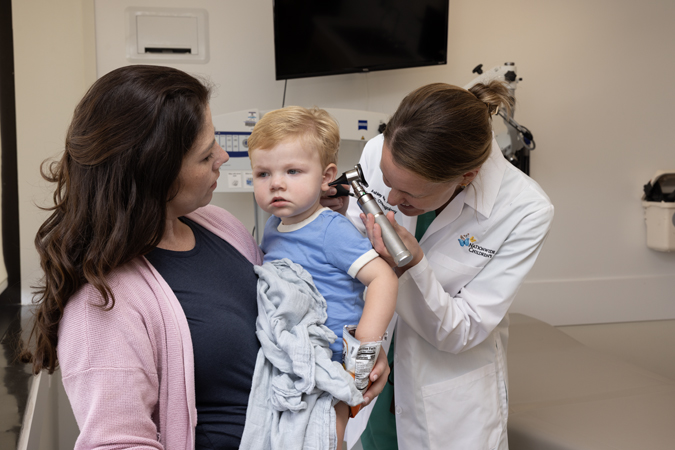
Nationwide Children’s Hospital is one of the only pediatric hospitals to offer in-office ear tubes as an established choice in their standard of care.
In the United States, bilateral myringotomy/ tympanostomy tube insertion (BTI), also known as ear tube surgery, is the most performed ambulatory pediatric surgery with about 667,000 children needing the procedure every year. Ear tubes treat children or adults with recurring ear infections, ear infections not responding to antibiotics or fluid trapped in the middle ear.
During the surgery, a small incision is made to the drain any trapped fluid from the middle ear, and a small tube is placed into the eardrum. For pediatric patients, this surgery is usually performed under general anesthesia in an operating room. About one in every 15 children will need ear tubes by the age of 3 years.
The frequent need for this procedure keeps the operating rooms in high demand. This means there are large gaps of time between the initial otolaryngologist evaluation for ear infections and the actual treatment. The timing and accessibility to operating rooms also varies between providers.
“Ear tube surgery is somewhat of a time-sensitive procedure,” says Charles Elmaraghy, MD, FAAP, FACS, chief of the Department of Otolaryngology at Nationwide Children’s Hospital. “It’s not an emergency, but for kids suffering with recurrent ear infections, they may have difficulty eating, sleeping and, most importantly, hearing, which may impact their speech and language development. Part of the quality of this procedure is not just the surgical procedure itself, but how quickly we can perform it.”
Harnessing the Power of Choice
In 2023, Dr. Elmaraghy and his team noticed reduced access to the operating room. Patients and their families were starting to go to other hospital systems because they were able to treat their child quicker. At the same time, a trend emerged in ENT, endorsed by the Academy of Otolaryngology, to do more office-based procedures. Additionally, families expressed growing concerns about the risks of general anesthesia for children.
This sparked a department-wide initiative from the Department of Otolaryngology at Nationwide Children’s to allow parents to choose between the standard ear tube surgery with general anesthesia or a different procedure: in-office BTI (IO-BTI), also known as in-office ear tube surgery. In-office ear tube surgery follows the same steps as BTI, but no general anesthesia is needed.
IO-BTI is not a new procedure. It has been traditionally reserved for a small number of pediatric patients who have potential health risks with general anesthesia. Now, it’s being used as a regular option at Nationwide Children’s. Good candidates for the procedure are usually patients 16 months or younger who have experienced three ear infections in six months, fluid in the ear for 3-6 months or ear infections not responding to antibiotics.
Dr. Elmaraghy and his team conducted a study, published in the International Journal of Pediatric Otorhinolaryngology, to evaluate the implementation and effectiveness of in-office ear tube surgery as a standard choice for patient families. The study found that IO-BTI is not only safe and cost-effective but maintains positive surgical outcomes for pediatric patients and increases satisfaction of their families.
By implementing this new protocol to add in-office ear tubes to the standard of care, Nationwide Children’s became one of the only pediatric hospitals in the United States to offer this procedure to every single candidate for ear tube surgery that walked through its doors. This means that patients will receive the same options and the same standard of care no matter what physician they see that day. Since its implementation in 2023, Nationwide Children’s has performed over 700 in-office ear tube surgeries.
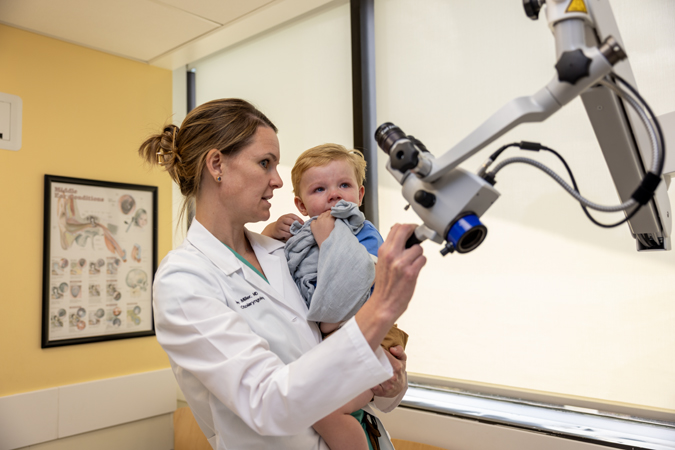
“As a new mom myself, I am able to flip the room,” says Ashley Miller, MD, physician in the Department of Otolaryngology at Nationwide Children’s and assistant professor of Clinical Otolaryngology at The Ohio State University College of Medicine. “I try to give families all the information necessary for them to compare the two options and make the best decision for their child. My daughter was recently evaluated in our clinic and underwent in-office ear tubes during the same visit — the convenience is really unparalleled. The recovery was even smoother than I expected, which has helped me to counsel other parents considering in-office tubes.”
Putting Families First
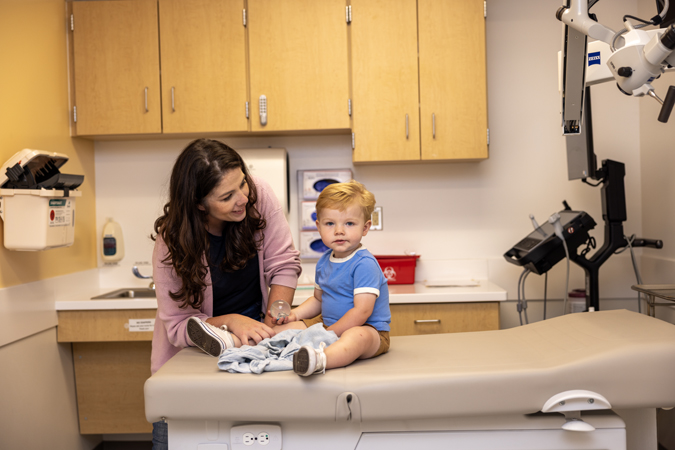
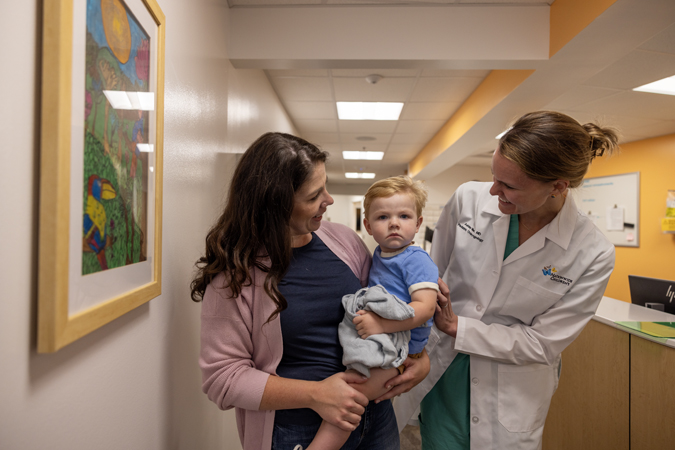
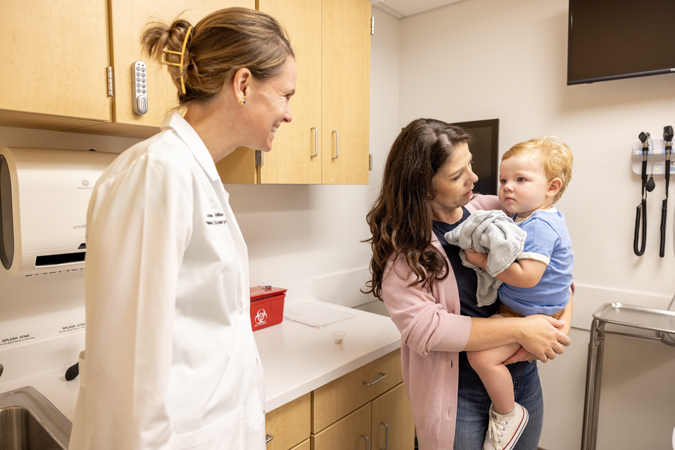
“It was important to us to avoid general anesthesia and try to pursue the right outcomes in the most minimally invasive way,” says Hillary Donkin, mother of Ansel Donkin, an 18-month-old boy who received in-office ear tubes at Nationwide Children’s in February 2025. “When the procedure came around, I expected it to be a bigger deal than it was. They gave Ansel some medicine before the procedure, put numbing drops in his ears, and I was sent to the waiting room. When I came back after a few minutes, the procedure was done, and I remember thinking how quiet it was. Dr. Miller was in the hallway holding Ansel and showing him pictures. It was such a striking moment because it wasn’t really a moment. It was just so normal.”
In-office ear tube surgery takes about 2-4 minutes and is performed in the clinic. The nurses at Nationwide Children’s are highly experienced with gentle holding to soothe the child or resolve any behavioral problems that could arise during the procedure. The recovery period is very short as they don’t have to spend time waking up from anesthesia.
“The operating room is still an acceptable way to perform the procedure,” says Dr. Elmaraghy. “However, the parent’s ability to now choose the in-office procedure depending on what is best for their child is what’s most important.
This article appeared in the 2025 Fall/Winter print issue. Download the issue here.
Reference:
Giroux K, McColl LF, Harter C, Seitz E, Kistler I, Chiang T, Jatana K, Elmaraghy C. Protocol implementation for in-office manual tympanostomy tube insertion. International Journal of Pediatric Otorhinolaryngology. 2025 May;192:112326.
Image credit: Nationwide Children’s
About the author

Alaina London (Doklovic) is a Marketing Specialist for Research Communications at Nationwide Children’s Hospital. She received her BS in medical anthropology and English from The Ohio State University. Her passions for science and health, combined with her desire to help others, motivated her to pursue a career in which she could actively help improve patient outcomes and scientific research through writing.
- Alaina Londonhttps://pediatricsnationwide.org/author/alaina-london/

- Alaina Londonhttps://pediatricsnationwide.org/author/alaina-london/
- Alaina Londonhttps://pediatricsnationwide.org/author/alaina-london/
- Alaina Londonhttps://pediatricsnationwide.org/author/alaina-london/