
Evaluation of New-to-Market Coin-Cell Battery and Medical Management Recommendations
Evaluation of New-to-Market Coin-Cell Battery and Medical Management Recommendations https://pediatricsnationwide.org/wp-content/uploads/2026/09/X-ray_Button-Battery-crop-1024x790.jpg 1024 790 Abbie Miller https://pediatricsnationwide.org/wp-content/uploads/2023/05/051023BT016-Abbie-Crop.jpg
First peer-reviewed evaluation of a commercially available esophageal-protective lithium coin-cell battery demonstrates substantially reduced tissue injury, but researchers emphasize that current emergency medical management should remain unchanged.
When a lithium coin-cell battery becomes lodged in a child’s esophagus, severe tissue injury can develop rapidly. According to the first peer-reviewed scientific evaluation of a commercially available esophageal-protective battery, a new titanium-based battery technology may significantly reduce the extent of tissue damage.
The study, led by Kris Jatana, MD, otolaryngologist–head and neck surgeon, surgical director of clinical outcomes, medical director of quality at Nationwide Children’s Hospital and professor of Otolaryngology–Head and Neck Surgery at The Ohio State University, was published in OTO Open.

Kris R. Jatana, MD
“Far too many children have experienced life-altering or life-threatening injuries from accidental battery ingestions in the home. With esophageal-protective batteries now commercially available, we anticipate meaningful improvements in patient outcomes,” says Dr. Jatana, an internationally recognized expert in button battery injury prevention and management.
Traditional lithium coin-cell batteries generate a highly alkaline environment when they contact moist tissue. If a battery becomes lodged in the esophagus, electrolysis can create a caustic burn capable of causing severe tissue destruction in as little as two hours. Battery-related pediatric emergency department visits have more than doubled over the past decade, according to data cited by the study authors.
In laboratory testing using a preclinical model, traditional batteries produced a diffusely alkaline pH of 13 and substantial visible tissue necrosis. In contrast, while the protective batteries still generated localized areas with a pH of 12–13, researchers observed markedly less tissue injury and no visible necrosis during the initial 60-minute experiments. At 24 hours, the protective batteries continued to demonstrate substantially less tissue damage compared with traditional batteries.
“This study provides the first assessment in the medical literature of an esophageal-protective battery technology after its introduction into the consumer market,” Dr. Jatana says. “The reduction in visible tissue injury is highly encouraging and illustrates the potential impact of incorporating child-safety considerations directly into battery design.”
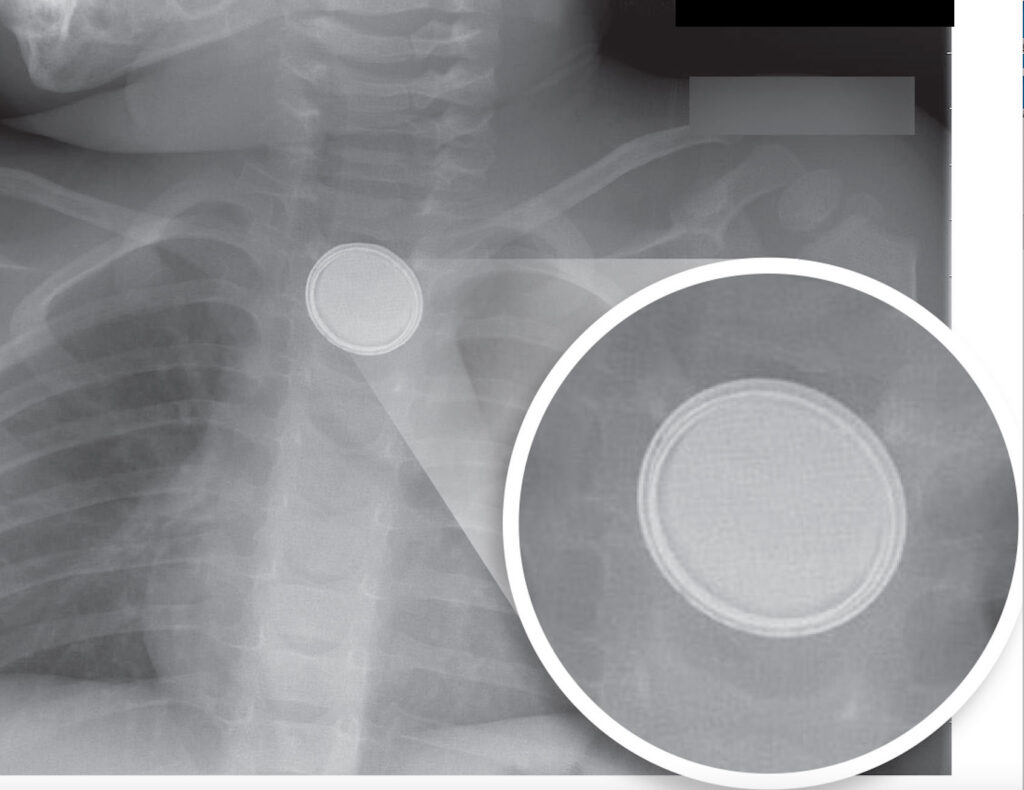
Importantly, the protective battery retained the characteristic “double-ring” or “halo” appearance on radiographs that clinicians use to distinguish button batteries from other ingested objects, such as coins. Researchers also evaluated the battery in combination with established injury-mitigation strategies. Honey, sucralfate and 0.25% acetic acid irrigation remained effective in neutralizing the alkaline environment.
These findings are significant because the investigators stress that the new technology should not change current medical management. A button battery lodged in the esophagus remains a medical emergency requiring prompt removal, and established pre-removal and post-removal mitigation protocols should continue to be followed.
The researchers call for additional studies, including histologic analyses and prospective evaluation of clinical outcomes in children who ingest esophageal-protective batteries. They also note that broader adoption of injury-reducing technologies by battery manufacturers, electronics companies, and consumer-product manufacturers represents a significant opportunity to further prevent devastating battery-ingestion injuries in children.
For clinicians, however, the message remains clear: while emerging battery technologies may lessen injury severity, an ingested button battery lodged in the esophagus remains a medical emergency requiring immediate evaluation and intervention.
Reference:
Jatana KR, Rhoades K, Litovitz T, Moore J, Cadotte AA, Mueller J, Dytso M, Jacobs IN. Evaluation of an Esophageal-Protective Lithium Coin-Cell Battery within Current Management Paradigms. OTO Open. 2026; DOI: 10.1002/oto2.70266
Image credit: Nationwide Children’s, courtesy of Dr. Jatana
About the author

Abbie (Roth) Miller, MS, MWC, is a passionate communicator of science. As the manager of medical and science content at Nationwide Children’s Hospital, she shares stories about innovative research and discovery with audiences ranging from parents to preeminent researchers and leaders. She is a Medical Writer Certified®, credentialed by the American Medical Writers Association, and received her masters of science in Health Communication from Boston University.
- Abbie Millerhttps://pediatricsnationwide.org/author/abbie-miller/

- Abbie Millerhttps://pediatricsnationwide.org/author/abbie-miller/
- Abbie Millerhttps://pediatricsnationwide.org/author/abbie-miller/
- Abbie Millerhttps://pediatricsnationwide.org/author/abbie-miller/